
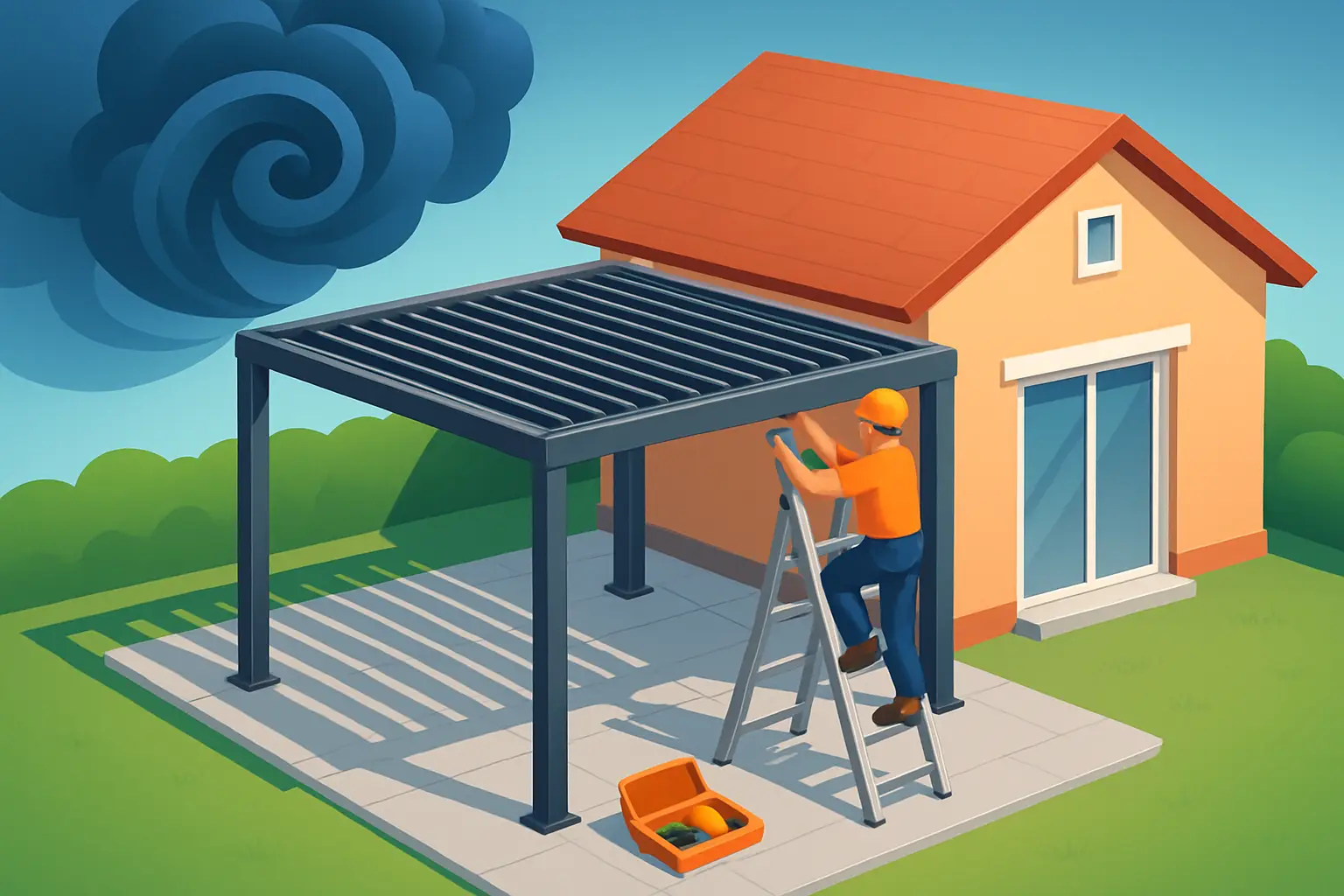
You can spot a Florida pergola that was built for the brochure instead of the forecast.
It looks perfect in calm weather, then the first real summer squall shows you the truth – racking in the frame, loose fasteners, uplift at the posts, and a roof system that was never engineered to behave like a structural assembly. In a state where wind, rain, salt air, and sudden pressure changes are normal, a pergola has to act like part of the home, not patio furniture.
If you are considering hurricane rated pergola installation Florida homeowners can rely on, the conversation should start with engineering and installation – not color samples.
What “hurricane-rated” should mean in Florida
Florida homeowners hear “hurricane-rated” all the time. The problem is that the phrase gets used for everything from a heavy-looking patio cover to a true engineered system with documented performance.
A meaningful hurricane rating ties back to design pressures and wind speeds, and it assumes the pergola is installed exactly as tested or engineered. If a manufacturer claims a high wind rating but the installer uses different anchors, changes post spacing, or skips required blocking, the real-world performance drops fast.
Hurricane-rated also does not mean indestructible. It means the structure is designed to resist wind loads up to a defined level when properly anchored to an appropriate foundation. The strongest pergola in the world can still fail if it is attached to a thin slab with inadequate embedment or if the load path is interrupted at any connection.
The hidden difference: wind rating vs. “it feels solid”
Many pergolas feel substantial when you push on a post. That tells you almost nothing about how the structure behaves under uplift and lateral loads.
Wind events apply complex forces: suction that tries to lift the roof, lateral pressure that pushes the frame sideways, and vibration that works fasteners loose over time. A hurricane-rated system addresses those forces with engineering – member sizing, connection design, post spacing, and most critically, anchoring that creates a continuous load path into concrete or approved structural framing.
If your goal is genuine peace of mind, ask for specifics. What wind speed is the system rated for? Under what configuration? What assumptions were made about the foundation? And who is responsible for ensuring the installed conditions match the engineered conditions?
Why aluminum dominates storm-ready pergola design
For Florida, architectural-grade aluminum is not just a style choice. It is a performance decision.
Wood can be beautiful, but it moves with humidity, demands ongoing maintenance, and its connections can loosen as fibers compress and swell. Steel can be strong, but in coastal areas it introduces corrosion management and finish concerns that homeowners often underestimate. High-quality aluminum systems, when properly designed, balance strength, weight, corrosion resistance, and precision manufacturing.
Precision matters because motorized louvered roofs and integrated lighting are not forgiving. A pergola that is slightly out of square can bind louvers, cause water management issues, and create long-term service headaches. In short, storm performance and day-to-day luxury often depend on the same thing: a rigid, correctly assembled structure.
The parts of hurricane-rated pergola installation that actually matter
A hurricane-rated product is only half the story. Installation is where Florida projects succeed or fail.
Site assessment and foundation reality
Before anyone talks about a final design, the installer should evaluate what the pergola will be anchored to: an existing slab, a pool deck, pavers over sand, a lanai, or a structural tie-in to the home.
Some slabs are excellent foundations. Others look fine until you discover they are thin, unreinforced, or have limited edge distance near the pool. Pavers almost always require additional structural planning because the paver field itself is not a structural foundation.
A professional plan accounts for these conditions instead of forcing the same anchor pattern onto every job.
A continuous load path, not just “strong screws”
In hurricanes, failures often begin at connections. The roof assembly must transfer loads into beams, beams into posts, and posts into the foundation. Each connection has to be designed for the load it will see.
This is where generic hardware becomes a liability. Proper installation uses specified anchors with correct embedment depth, torque, edge distance, and spacing. It may require epoxy-set anchors, through-bolting, or engineered brackets depending on the slab and the design pressures.
If your installer cannot explain the load path in plain English, that is a warning sign.
Layout, squareness, and tolerances
Luxury pergolas with motorized louvers require clean geometry. A small layout error can compound across the frame, affecting louver alignment, drainage performance, and noise.
High-end installers treat layout like finish carpentry and structural framing combined. Expect careful measurements, laser alignment, and verification before anchors are drilled.
Water management that matches Florida rain
A pergola is not a sealed roof. Even louvered systems that shed rain are designed around controlled water movement, not absolute waterproofing in every condition.
A quality installation plans for where water goes when the louvers are closed, how gutters and downspouts route flow, and what happens during wind-driven rain. This is especially important over outdoor kitchens, seating areas, and door thresholds.
Permits, code, and HOA: what to expect
For most Florida municipalities, a pergola is not a casual weekend project. Permitting can be required depending on size, attachment to the home, and local interpretations.
A proper contractor helps you navigate this. Expect drawings or engineered documents as needed, clear communication about timelines, and coordination that keeps the project moving without surprises.
HOAs can add another layer. The best approach is to plan for HOA review early – including finish color, roof style, height, and placement. A contractor used to Florida communities will anticipate what reviewers ask for and prevent the back-and-forth that delays installations.
Motorized louvers and integrated tech: luxury that must be installed like a system
Florida homeowners choose motorized louvers because they want control: sun when they want it, shade when they need it, and rain protection that turns an outdoor space into a true extension of the home.
That convenience depends on correct installation details: routing wiring cleanly, protecting connections from moisture, aligning louvers for smooth operation, and verifying that drainage components are seated and sealed where required.
Integrated lighting and optional automated shades raise the stakes further. They are not add-ons you want handled casually. A premium installer treats them as part of the architecture, with thoughtful placement and a clean, intentional finish.
Trade-offs and “it depends” decisions (the honest part)
Even with hurricane-rated systems, there are real choices that affect performance, comfort, and cost.
A freestanding pergola can be ideal when you want flexibility in placement, but it may require more foundation planning because it cannot borrow support from the home. A wall-attached configuration can create a strong integration with the house, but it demands careful flashing and connection detailing to protect the building envelope.
Size and span matter too. Bigger is not just more expensive – it changes structural requirements, post placement, and sometimes the feel of the space. Some homeowners want a wide, open span with fewer posts for a cleaner look, but that often requires heavier members and more engineering.
Finally, wind rating is not a single number you “buy.” It is tied to configuration. The same system can have different ratings depending on dimensions, height, roof style, and exposure.
What to look for in a Florida pergola contractor
A hurricane-rated pergola is a high-ticket outdoor living investment. The contractor you choose should operate like a builder, not a reseller.
Look for a process that feels deliberate: site evaluation, clear design options, transparent pricing, permit support where required, and proactive updates from start to finish. Then verify the proof points that reduce ownership risk – engineering documentation, material quality, and warranty coverage that matches the premium claim.
If you want the shortest path to confidence, choose a company that designs, supplies, and installs the system under one roof so responsibility does not get passed around when details matter.
For homeowners who want architectural-grade aluminum systems engineered for Florida weather, enVision Pergola positions its builds around hurricane-rated performance up to 185 mph, a concierge-style install process, and long warranty coverage (20-year structural and 20-year motors and lighting) – the kind of specifics that make “luxury” feel measurable.
Financing and timing: making a premium project practical
Many Florida homeowners delay outdoor upgrades because they assume a large upfront payment is the only path. Premium pergola projects do not have to be planned that way.
If financing is available with no money down and longer terms for qualified buyers, it can let you build the space you actually want now – especially if you are planning around seasonal entertaining, a new pool, or a home renovation schedule.
Timing matters too. Permit reviews, HOA approvals, and custom fabrication can take time, and storm season does not wait. If your goal is to have a finished, storm-ready structure before peak weather, the best move is to start the design and approval process early rather than shopping at the last minute.
Closing thought
A pergola in Florida should earn its place on your property twice – once when it turns a patio into a daily luxury, and again when the wind picks up and you are grateful it was installed like a structural system, not a decoration.