
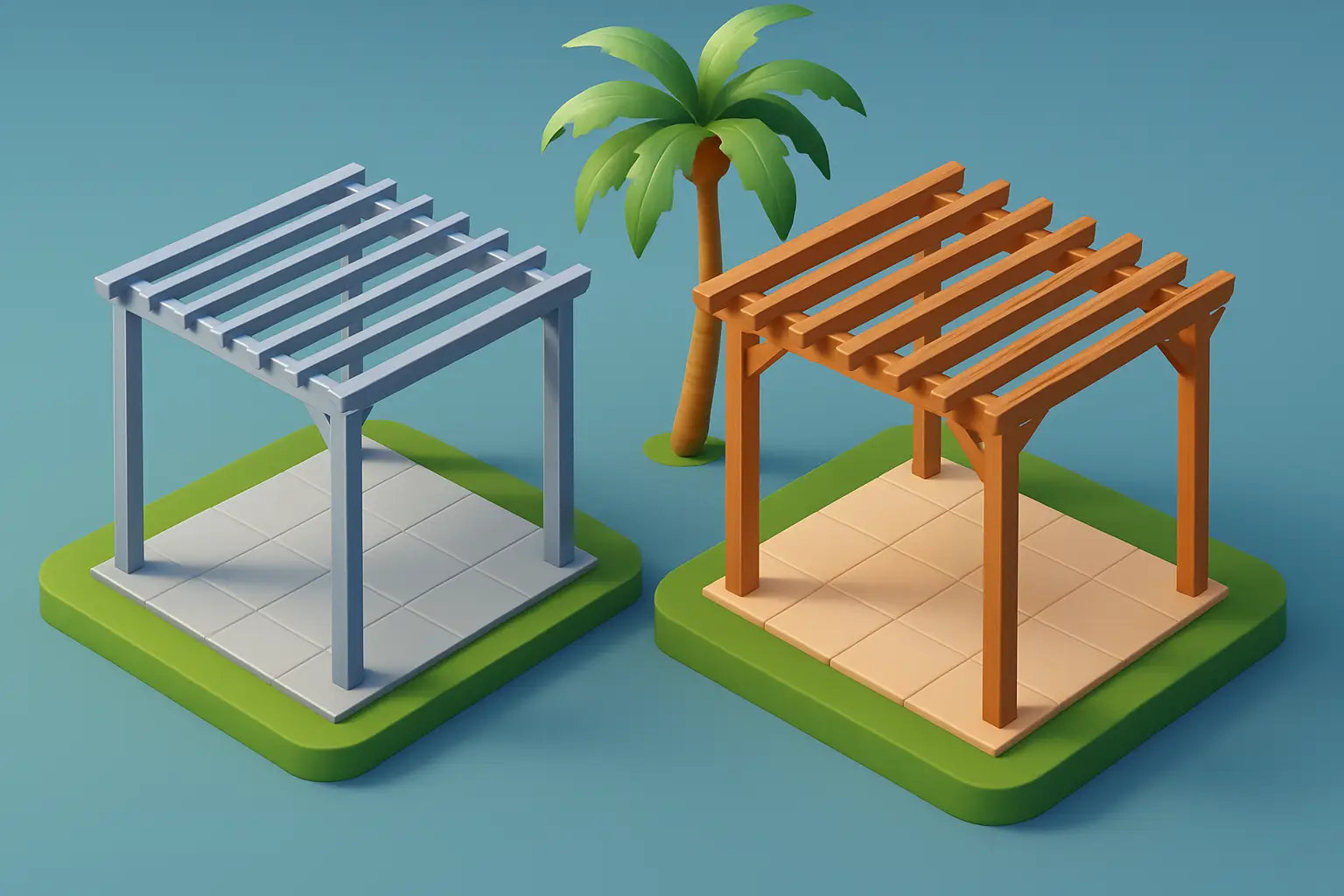
At 4:00 pm in July, your patio is either the best seat in the house or an oven with a view. In Florida, a pergola is not just a design feature – it is a daily comfort decision that has to survive UV, salt air, rain that blows sideways, and the occasional named storm.
If you are weighing aluminum pergola vs wood in Florida, the right answer is rarely about “what looks nicer.” It is about what stays straight, operates reliably, and still looks intentional after years of humidity, heat, and hurricane season.
The Florida test: what actually breaks pergolas here
Florida stresses outdoor structures in ways many homeowners do not fully appreciate until they have owned one. UV exposure is relentless, which punishes stains, paints, and cheaper composites. Moisture cycles happen constantly – afternoon downpours, overnight dew, irrigation overspray, then intense sun. Near the coast, salt can accelerate corrosion and eat away at fasteners.
Wind is the headline risk. Even if your neighborhood never sees the eyewall, tropical systems bring repeated gust events that rack structures, loosen connections, and turn shade features into sails.
A pergola in Florida is a small building element. The material you choose determines how well it handles those forces without warping, splitting, rotting, or gradually “walking” out of square.
Aluminum pergola vs wood in Florida: what the materials really mean
Wood pergolas are often chosen for warmth and tradition. They can look beautiful when freshly built, especially with decorative rafters or a classic stained finish. Aluminum pergolas are chosen for geometry, longevity, and modern outdoor-living features like motorized louvers, integrated lighting, and automated shades.
But the real difference is not aesthetic. It is how each material behaves over time.
Wood is an organic material. It expands and contracts with moisture, can check and split under sun load, and requires surface protection to slow down decay. In Florida, the speed of that cycle is simply faster.
Architectural-grade aluminum is dimensionally stable. It does not swell from humidity, and it supports engineered connection systems that stay tight. That stability becomes especially important if you want moving parts like louvers or screens to remain aligned and smooth.
Wind and hurricane performance: engineering vs carpentry
If you live in a hurricane-prone region, your pergola should be treated like a structural project, not a weekend upgrade.
A wood pergola can be built strong, but its performance depends heavily on the builder, the quality of the lumber, and the connection details. Fasteners can loosen as wood fibers compress. Posts can twist. Hardware can corrode. Even when the structure survives, it can shift just enough to create squeaks, cracked finish lines, or a “lean” that becomes obvious once you see it.
Aluminum pergola systems are typically designed as engineered assemblies with tested load paths – posts, beams, anchors, and fasteners working together as a set. When those systems are hurricane-rated, you are buying a performance claim backed by engineering, not just an assumption.
If your goal is peace of mind through storm season, aluminum tends to be the more predictable route, especially when paired with professional installation and proper anchoring into concrete or structural framing.
Sun, rain, and comfort: shade control is where aluminum separates
Wood pergolas are usually “open roof” by default. They create pattern shade, which looks great but does not necessarily reduce heat the way homeowners expect at midday. You can add a canopy or polycarbonate panels, but now you are mixing materials and adding components that need their own maintenance.
Aluminum pergolas are where true control becomes realistic. A louvered aluminum roof can shift from full sun to filtered shade to near-closed rain protection, depending on the system. In Florida, that matters because weather changes quickly. A space that is usable at noon, then during a pop-up shower, then again for dinner is an entirely different lifestyle upgrade than a structure that simply looks good in photos.
Integrated lighting is another practical difference. With many aluminum systems, lighting is built into the design rather than retrofitted. That means cleaner lines, fewer exposed wires, and a finished feel that matches a luxury home.
Maintenance reality: what you will actually do year after year
Most homeowners do not mind maintenance. They mind surprise maintenance.
Wood pergolas require a commitment that is easy to underestimate in Florida. Expect periodic cleaning for mildew and algae. Expect refinishing cycles to keep color from washing out and to protect against moisture intrusion. And if you are near the coast, hardware and connectors deserve attention because salt exposure finds weak points.
Even with good care, wood can still move. That movement is not a defect – it is the nature of the material. The question is whether you want that behavior in a structure you look at every day.
Aluminum pergolas are typically closer to “wash and enjoy.” Cleaning is generally a simple rinse and light scrub where needed. Finishes are designed for exterior exposure, and the structure itself does not rot, splinter, or become a termite project.
If your vision is a patio that stays crisp and intentional with minimal upkeep, aluminum is hard to beat.
Termites, rot, and humidity: the Florida wood tax
Florida homeowners do not need to be sold on termite risk. It is a reality of life here.
A wood pergola introduces more wood mass outdoors, often close to landscaping and moisture. Pressure-treated lumber helps, but it is not a permanent force field. Fastener penetrations, end grain, and small cracks become entry points for water, which can lead to rot. Once rot starts, it is not cosmetic – it is structural.
Aluminum is not a food source. It does not rot. That alone changes the ownership equation, especially for homeowners who travel, maintain multiple properties, or simply do not want to babysit an outdoor structure.
Aesthetics and architecture: traditional charm vs modern precision
Wood has a natural warmth that many homeowners love, especially on older homes, coastal cottages, and Mediterranean-inspired properties where timber looks historically appropriate.
Aluminum leans modern and architectural. Lines are straighter, corners are cleaner, and color options can be selected to match window frames, railings, or contemporary exterior palettes. If your home already features black or bronze metal accents, an aluminum pergola often looks like it was part of the original plan.
The best approach is to match the pergola to the home’s architecture and your outdoor goals. If you want a “garden structure” feeling, wood can be perfect. If you want an outdoor room that reads as an extension of the home, aluminum typically delivers that built-in look.
Cost over time: upfront price vs ownership cost
Wood often wins the initial price conversation, especially for simpler, open-roof builds. But Florida ownership costs show up in maintenance, refinishing, repairs, and in how long the structure stays attractive before it starts to look tired.
Aluminum pergolas can cost more upfront, especially when you add motorized louvers, lighting, and shades. The payoff is reduced maintenance, longer visual life, and better day-to-day usability. In other words, you are not just buying a structure – you are buying control and consistency.
For homeowners who plan to stay in their home, the “cost per year of enjoyment” is often where aluminum makes the most sense.
Permits, installation, and workmanship: where projects succeed or fail
Florida is not the place to gamble on shortcuts. The difference between a pergola that feels permanent and one that feels like a kit often comes down to anchoring, layout, and finishing.
Wood pergolas can be built beautifully, but the final quality depends on carpentry skill and jobsite discipline. Inconsistent cuts, imperfect post placement, or rushed sealing can show up later as twist, sag, or water intrusion.
Engineered aluminum systems still require expert installation. Square, plumb, correct fasteners, and proper attachment to the slab or structure are non-negotiable. The advantage is that the system components are designed to work together, which reduces guesswork when installed by a professional crew.
If you are aiming for a luxury result, prioritize the installer as much as the material.
Who should pick wood in Florida?
Wood can be the right choice if you love natural material, you do not mind ongoing refinishing, and you want a traditional, open-roof pergola with a softer visual presence. It also fits well when the pergola is more decorative than functional, such as defining a garden path or framing a seating area used primarily in mild seasons.
The trade-off is that you are signing up for maintenance and accepting that Florida will gradually imprint itself on the structure.
Who should pick aluminum in Florida?
Aluminum is usually the better fit if you want your pergola to perform like an outdoor room: controlled shade, rain management, integrated lighting, optional screens, and a design that stays straight and clean. It is also the stronger choice for homeowners in coastal areas or anyone who wants hurricane-minded engineering rather than hoping a structure holds.
If you are exploring a premium, hurricane-rated aluminum system with motorized louvers, integrated lighting, and long warranty coverage, enVision Pergola is built around that performance-first approach and a concierge-style process that keeps expectations clear from design through installation.
The decision that usually makes itself
A simple question tends to settle aluminum pergola vs wood in Florida: do you want a beautiful structure, or do you want a controllable outdoor living space that behaves like part of your home?
If you picture weekend sanding, staining, and checking for soft spots as the cost of owning something classic, wood can be satisfying. If you picture pressing a button to angle louvers, keep dinner dry through a quick shower, and walk outside to a space that looks the same season after season, aluminum will feel like the more Florida-proof investment.
Your patio should not be a fair-weather luxury. It should be the place you use when the weather does what Florida does.