
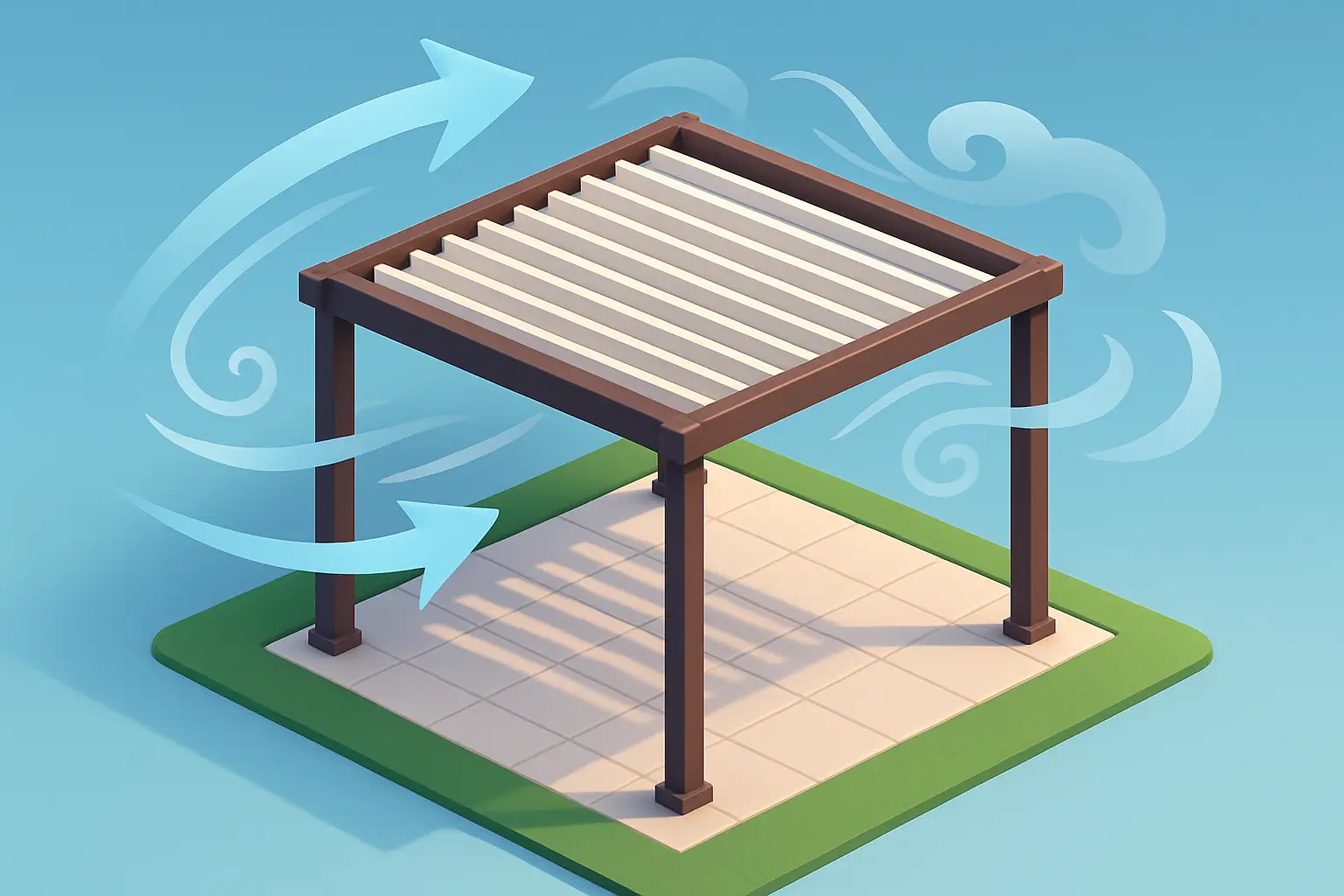
Your patio can look perfect at 5:00 pm and become a sail at 5:15 pm. If you live near the coast or in a hurricane-prone pocket of Florida, you already know how fast “breezy” turns into bent aluminum, rattling panels, and a warranty argument.
Choosing the best pergola for high wind areas is less about finding the prettiest roofline and more about selecting a system that behaves like part of the house – engineered, anchored, and rated for the reality of your zip code.
What “high wind” really means for a pergola
Wind problems rarely come from a steady breeze. The damage happens during gusts and pressure shifts, especially when wind hits a structure from below or at an angle. That creates uplift, racking (side-to-side sway), and fastener fatigue. Over time, even “minor” movement works hardware loose, causes squeaks, and leads to water intrusion where components start to separate.
In coastal climates, wind is usually paired with salt, humidity, and heavy rain. So the right pergola is a whole system decision: material, connections, footings, roof behavior, and whether the installer understands local codes and site conditions.
The best pergola for high wind areas starts with a real wind rating
A wind rating is not marketing language. It is an engineering claim tied to how the pergola is designed, what it is anchored to, and what loads it can resist without failure.
For homeowners, the practical takeaway is simple: ask what wind speed the system is rated for, and what assumptions that rating requires. Does it assume a certain post size? A certain number of anchors per post? A specific slab thickness? A particular mounting condition (freestanding vs. attached to the home)? If the “rating” disappears the moment your layout changes, it is not the kind of certainty you want when the forecast turns serious.
If you want peace of mind in Florida, look for hurricane-rated systems that are engineered for extreme gusts and that can be permitted and installed as a code-aligned structure, not a decorative kit.
Why architectural-grade aluminum wins in wind-prone regions
Wood can be beautiful, but it is not naturally consistent. Knots, grain direction, moisture movement, and long-term checking all affect how a wooden pergola holds fasteners and stays square. In high wind, that matters.
Architectural-grade aluminum pergolas are favored in storm regions because the material is dimensionally stable, corrosion-resistant when properly finished, and strong for its weight. That strength-to-weight ratio is important: you want a structure that resists uplift and racking, but you also want clean lines and modern proportions that do not require oversized beams.
Aluminum also plays well with integrated technology like motorized louvers, lighting, and automated shades, which is often where luxury outdoor living is heading. The engineering challenge is doing that without introducing weak points – the best systems treat motors, wiring paths, and drainage as part of the structural plan.
The roof decision: open-top, solid, or louvered
In high wind areas, the roof style changes everything because it determines how wind loads the pergola.
An open-top pergola reduces uplift because wind can pass through. That can be a sensible approach if your main goal is shade patterns and light architectural definition. The trade-off is comfort. You are still exposed to driving rain, intense sun angles, and the heat load that makes outdoor spaces unusable in mid-summer.
A solid roof adds true rain protection, but it can also increase uplift and pressure if not engineered correctly. It behaves more like a sail, so the structure and anchoring need to be correspondingly stronger.
Motorized louvered roofs can be the most versatile option when they are engineered for wind. The benefit is control: tilt louvers to manage sun, close them for rain, and open them when conditions are safe to reduce uplift and relieve pressure. The trade-off is that louvered systems are mechanically complex, so build quality and warranty coverage matter. In wind-prone regions, you want a system designed so louvers, pins, and drive components are not the first point of failure.
Anchoring is where “high wind ready” becomes real
Most pergola failures are not because the beam was too thin. They happen because the pergola was not properly tied into a foundation that could resist uplift and lateral loads.
A high-wind pergola should be anchored based on what it is mounting to: reinforced concrete slab, footer, stem wall, pavers over concrete, or a structural deck. Each condition requires a different approach. Pavers alone are not a structural substrate. Neither is thin concrete with unknown reinforcement.
You should expect a credible installer to talk about embed depth, anchor type, spacing, and edge distance. If the plan is “we’ll use a few wedge anchors and call it good,” you are looking at a fair-weather installation.
Attached pergolas add another layer. Fastening to fascia is not the same as tying into structural framing. In high wind areas, the load path matters: wind load must travel from roof to beams to posts to anchors to concrete without relying on trim boards or non-structural elements.
Don’t ignore racking resistance and connection design
Wind is not only vertical uplift. Gusts push laterally, and that sideways load is what causes wobble, squeaks, and long-term loosening.
Racking resistance comes from beam design, post size, internal reinforcement (when used), and the quality of the connections. In premium aluminum pergolas, connections are engineered and often concealed, which is both cleaner visually and better structurally when done right.
This is also where “kit” pergolas tend to struggle. A kit can look substantial on day one, but if it relies on light brackets and generic screws, it may not stay tight after a season of gusts and thermal expansion.
Salt air, finish quality, and why coastal durability is not optional
High wind areas in Florida are often coastal, and salt is relentless. It finds exposed fasteners, creeps into seams, and accelerates corrosion where dissimilar metals touch.
Look for powder-coated aluminum with a finish system intended for exterior architectural use, paired with corrosion-resistant hardware. Ask what fasteners are used and whether the system is designed to shed water and avoid trapping moisture inside channels.
Durability is also about maintenance. The best systems are designed to stay aligned, keep drainage functioning, and operate smoothly even after months of sun, rain, and salt-laden humidity.
Screens and shades: comfort upgrades that must be wind-smart
Automated shades and screens can transform a pergola into a true outdoor room, especially near a pool deck or lanai where low sun and bugs are daily realities.
But in high wind, anything that creates a vertical surface can catch gusts. That does not mean you should avoid shades. It means you should choose systems designed with wind in mind, installed with the right clearances and guides, and used correctly. Many homeowners keep shades retracted when storms are approaching, then deploy them for comfort when conditions are calm.
A consultative builder should talk through how your yard funnels wind, how your home blocks or accelerates gusts, and where shades make sense without turning the pergola into a wind screen at the worst possible moment.
The permit and engineering conversation you actually want to have
In Florida, a pergola is often more than a backyard accessory. Depending on size, attachment, and roof type, it can require permitting and engineering.
Instead of treating that as a headache, use it as a filter. The best pergola for high wind areas is the one that can be designed and installed with clear documentation, code awareness, and a defined load path. Ask who handles permitting, what drawings are provided, and how site conditions are verified before anchors go in.
That conversation is usually where premium builders separate themselves: you get clear expectations, proactive updates, and an installation plan that is built for your property rather than a one-size-fits-all layout.
Warranties matter more when there are motors and storms
A high-end louvered pergola is a long-term ownership decision. If you are investing in motorization, integrated lighting, and optional automated shades, warranty terms become part of the product, not fine print.
Look for strong structural coverage and meaningful protection for motors and lighting components. Also pay attention to what is excluded. “Warranty against defects” is not the same as warranty coverage that reflects real outdoor use in harsh climates.
If you want a benchmark for what premium, engineering-forward looks like in Florida, enVision Pergola positions its custom aluminum systems as hurricane-rated up to 185 mph with 20-year structural and 20-year motors and lighting coverage, delivered through a full-service design-and-install process.
How to choose the right system for your yard
The right pergola is the one that matches your wind exposure and how you plan to live outside.
If you are on open water, on a corner lot with no wind breaks, or you regularly see strong gusts, prioritize wind rating, anchoring strategy, and racking resistance first. A louvered roof can still be a great choice, but only if it is engineered for that environment and installed with a real foundation plan.
If your patio is partially protected by the home and landscaping, you may have more flexibility in roof style and enclosure features. That is where integrated lighting and shades tend to deliver the biggest day-to-day value, turning a nice-looking space into a functional one.
And if you are trying to balance budget with performance, focus on the components that are hardest to upgrade later: structure, anchors, and roof system. Lighting, heaters, and accessories can often be added or expanded over time, but you cannot “retrofit” wind engineering after the fact.
A pergola in a high wind area should feel like it belongs to the architecture of your home – not just visually, but structurally. When the forecast changes, the goal is simple: you close up, you go inside, and you do not spend the night listening for rattles.