
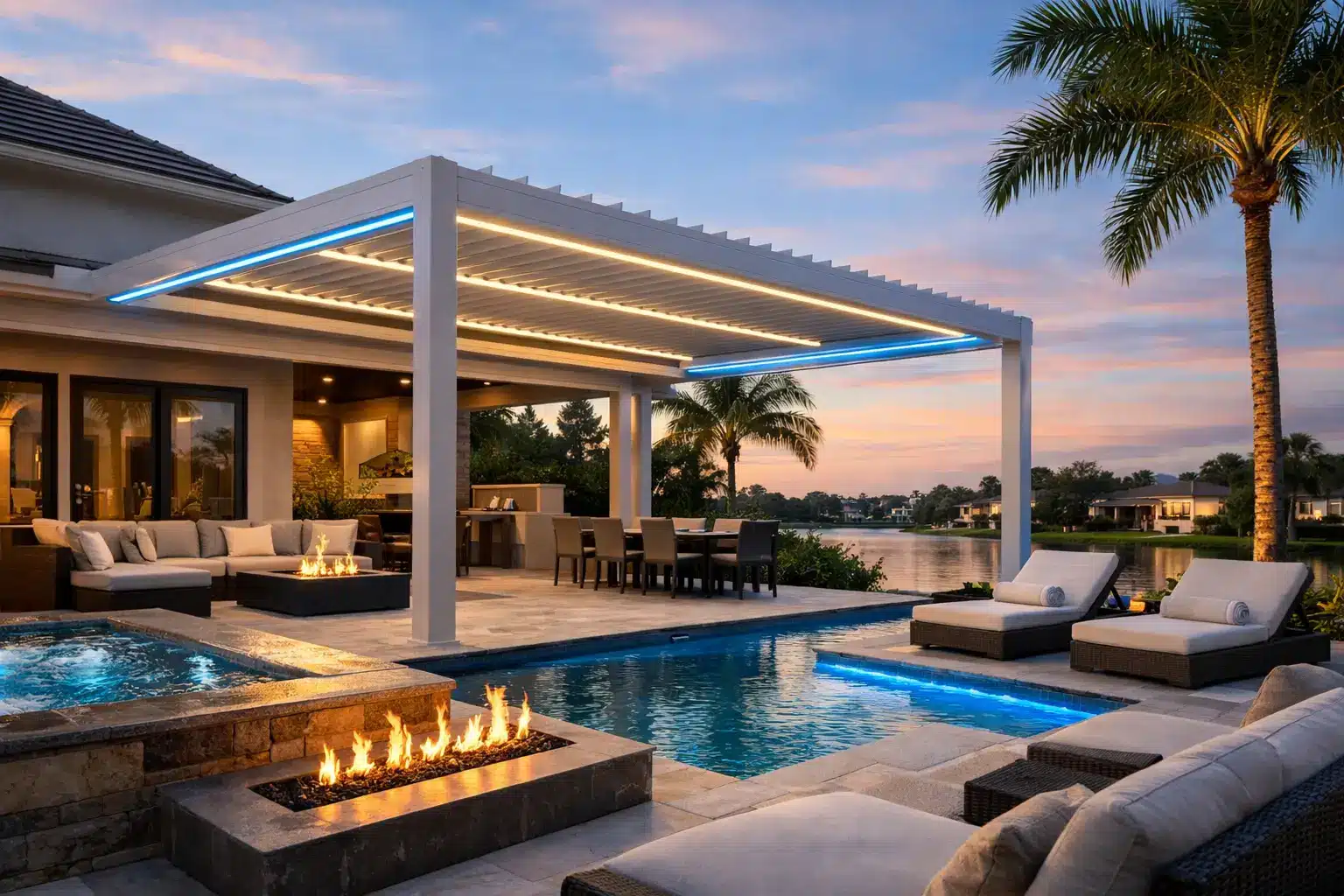
A beautiful backyard is no longer just a pool, a few loungers, and a grill pushed against the wall. The most relevant luxury backyard trends are about creating a space that performs like a true extension of the home – comfortable at noon, inviting after sunset, and engineered to handle Florida weather without constant compromise.
For high-end homeowners, that shift matters. If you entertain often, spend time outside year-round, or simply expect more from your property, the backyard has become one of the smartest places to invest. The difference is that luxury today is not only visual. It is measured in comfort, control, durability, and how confidently the space holds up over time.
Luxury backyard trends are moving beyond decoration
For years, upscale outdoor design leaned heavily on appearance. Clean lines, premium finishes, and resort-inspired layouts still matter, but homeowners are asking better questions now. How much shade do you get at 2 p.m.? Can the space adapt when rain moves in? Will the materials still look exceptional after years of heat, salt air, and storms?
That is why the strongest projects are less about adding isolated features and more about building an outdoor environment with intention. In Florida, especially, luxury has to work hard. A backyard that looks impressive in photos but becomes unusable in strong sun, humidity, or changing weather does not feel premium for long.
The rise of architectural outdoor rooms
One of the clearest luxury backyard trends is the move toward defined outdoor rooms. Instead of a patio being treated as leftover square footage, it is designed like a destination. Dining areas, lounge zones, poolside retreats, and covered entertaining spaces are laid out with the same discipline used inside the home.
This approach creates more than beauty. It gives the backyard rhythm and purpose. A covered lounge beside an open sun shelf, for example, creates contrast. A dining space positioned under a motorized pergola feels usable in a way that an exposed table rarely does. The result is a property that feels composed rather than pieced together.
For larger homes, this often means connecting architecture and landscape more closely. Ceiling lines, columns, finishes, and lighting are treated as part of the home’s design language, not an afterthought added later.
Pergolas are now performance features, not accents
This is where many outdoor projects either become exceptional or stay ordinary. A pergola used to be seen as a decorative structure. In luxury design, that view has changed. Today, advanced pergola systems are expected to provide real control over sun, shade, airflow, and rain protection.
Motorized louvers are a major reason. They allow homeowners to adjust overhead coverage throughout the day, which changes how the space feels hour by hour. Open the louvers for light and ventilation in the morning, tilt them for filtered shade in the afternoon, and close them when a passing storm rolls in.
That flexibility is especially important in Florida, where outdoor living is desirable nearly year-round but only when the environment is managed properly. The premium homeowner is not looking for a structure that simply looks substantial. They want one that is engineered for the climate, integrated into the home, and backed by long-term performance.
Integrated lighting is replacing stand-alone fixtures
Luxury backyards no longer rely on a few scattered fixtures to make the space usable at night. One of the most refined shifts in current design is integrated lighting built directly into the architecture. When lighting is planned from the beginning, the backyard feels calmer, more intentional, and far more upscale.
Under-pergola lighting is a strong example because it serves both function and atmosphere. It supports dining, conversation, and evening entertaining without the glare or visual clutter of too many separate fixtures. Clean overhead illumination also helps the space transition from daytime retreat to nighttime gathering area without feeling like two different environments.
There is a practical side to this trend as well. Integrated systems tend to feel more permanent and more polished, but they also reduce the number of exposed elements that can age unevenly outdoors. That matters for homeowners who care about clean sightlines and low-maintenance ownership.
Shade and weather control are now expected
In a true luxury backyard, comfort is not left to chance. That is why adjustable shade systems and weather-responsive design have become standard in high-end projects. In Florida, the demand is even stronger because sun exposure, sudden rain, and wind can quickly limit how often a space gets used.
Automated shades are increasingly popular because they add another layer of control without sacrificing a tailored appearance. They can help cut glare, improve privacy, and make a covered lounge or dining area feel more protected. For homes near the coast or on exposed lots, that extra control can turn a beautiful space into one that gets used every week.
Still, this trend comes with a design decision. Too much enclosure can make an outdoor area feel closed off, while too little protection can make it uncomfortable. The best projects strike a balance – preserving openness while giving homeowners the ability to adapt when conditions change.
Premium materials are being chosen for longevity, not just looks
Luxury buyers have become more selective about what goes into the backyard, and rightly so. Materials that perform well in mild climates may not deliver the same result in Florida. Heat, humidity, salt exposure, and storm conditions put every finish and structure under pressure.
That is why aluminum has become central to many premium outdoor builds. Architectural-grade aluminum offers the clean, modern profile homeowners want, but the real advantage is long-term resilience. It resists many of the issues that shorten the life of lesser materials, and it supports a more engineered, substantial feel.
For buyers making a significant investment, this is not a minor detail. A luxury installation should not create ongoing ownership anxiety. Strong warranties, tested systems, and hurricane-rated engineering are increasingly part of the decision, particularly in coastal and storm-prone markets. In places like Naples, Boca Raton, and Tampa, performance claims are not marketing extras. They are part of what makes a project worth doing.
Technology is becoming quieter and more useful
Not every trend in luxury design deserves attention. Some feel impressive at first and become unnecessary later. The outdoor technology that is lasting tends to be the kind that improves daily use without demanding attention.
Motorization fits that standard. So does integrated control over louvers, lighting, and shades. These features are valuable because they remove friction. You do not have to rearrange your plans because the sun shifted or a light rain started. You make an adjustment and continue using the space.
That said, more technology is not automatically better. The right system depends on how you live. Some homeowners want full convenience and automation. Others prefer a simpler setup with fewer moving parts. The luxury position is not excess for its own sake. It is choosing the features that make the space feel effortless.
Entertaining spaces are becoming more private and more polished
Another notable change in luxury backyard trends is the move away from exposed entertaining areas. Homeowners still want open-air living, but they also want more privacy, more comfort, and a stronger sense of retreat.
This shows up in the way outdoor seating areas are positioned, covered, and framed. A pergola over a lounge space creates visual definition and a feeling of shelter. Integrated shades add discretion without making the space feel heavy. Lighting keeps the area elegant after dark rather than overly bright. Together, these choices create an atmosphere that feels closer to a private club terrace than a standard patio.
That privacy is particularly valuable in denser neighborhoods or on waterfront lots where views are a benefit but exposure can be a trade-off. The strongest designs recognize both.
What homeowners should prioritize before following trends
Trends are useful only when they align with the property and the way you actually live. A feature that looks current today will not feel luxurious later if it does not solve a real problem or support the architecture of the home.
Start with use. Do you want a better poolside lounge, a more functional dining area, or true all-weather coverage for entertaining? Then consider the environmental demands of the site. Sun orientation, wind exposure, proximity to salt air, and drainage all shape what will perform well.
After that, evaluate the build team with the same care you would apply to any major home improvement. Design matters, but so do permitting, engineering, installation quality, and communication. A concierge-style process is not just a convenience at this level. It is part of protecting the investment.
A well-designed backyard should feel easy the moment you step into it. Not because it is simple, but because every decision behind it was made with precision. The best outdoor spaces do not chase trends for their own sake. They give you more comfort, more confidence, and more reasons to be outside.