
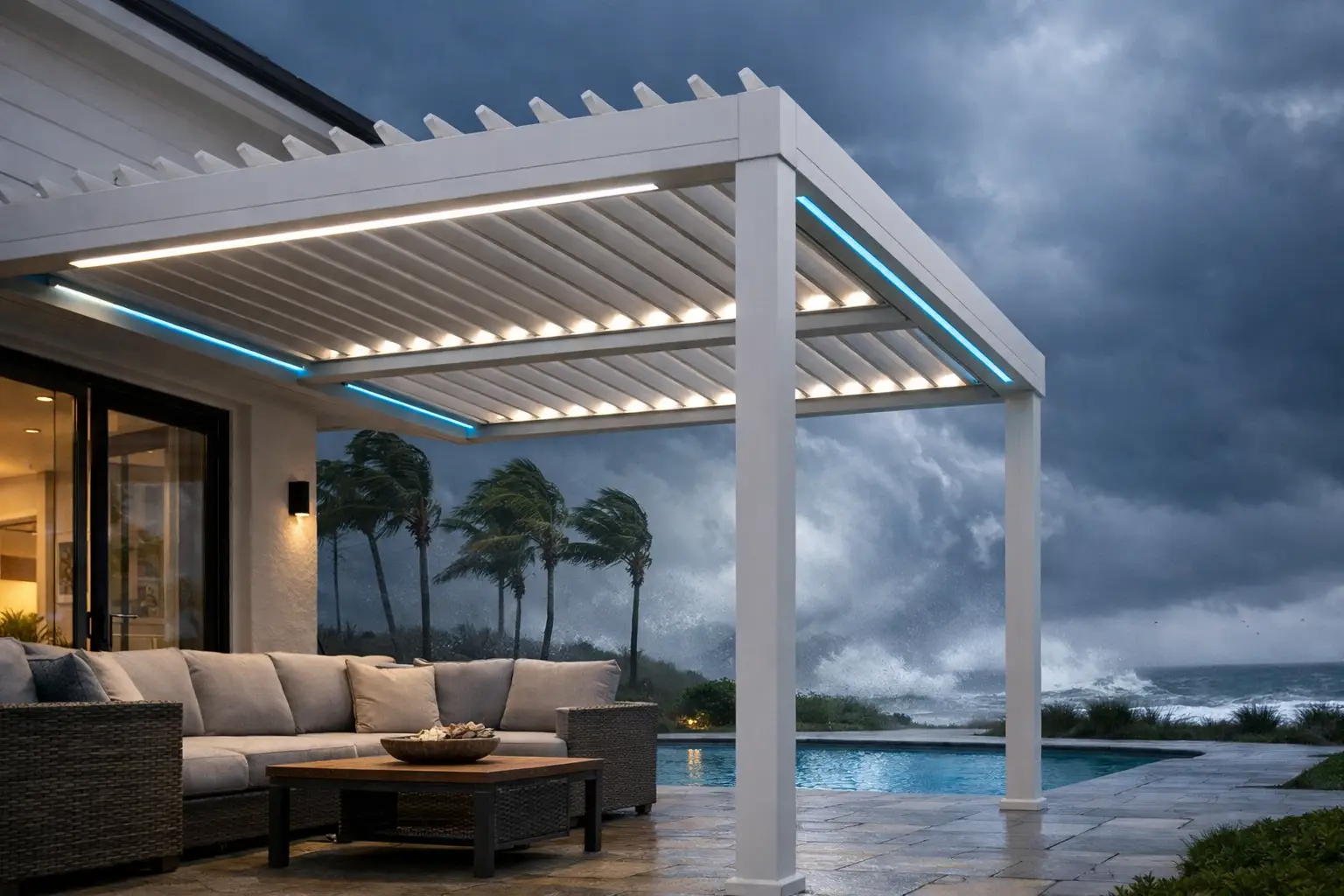
A pergola can look stunning on a pool deck and still be the wrong choice for Florida. The difference often comes down to one phrase homeowners see everywhere but rarely get explained clearly: hurricane rated. If you are investing in a luxury outdoor structure in a coastal or storm-prone market, that label should mean more than marketing copy.
For high-end homes, a pergola is not just shade. It is part of the architecture, part of the entertaining space, and part of the long-term value of the property. That raises the standard. You are not simply choosing a design you like. You are choosing whether the system has been engineered, permitted, and installed to perform when weather turns serious.
What hurricane rated means in practice
At its simplest, hurricane rated means a structure has been designed and tested or engineered to meet specific wind load requirements. That sounds straightforward, but there is nuance here. A product may be described as strong, storm resistant, or durable without actually being hurricane rated in a way that matters for your property.
The real question is not whether a pergola can handle bad weather in general. The real question is whether that exact system, at that exact size, installed in that exact location, meets the required wind loads under local code. In Florida, that distinction matters.
A genuine hurricane rated pergola should be backed by engineering documentation, code compliance, and a permit path that reflects the conditions of the home. It is not only about the frame. It also involves attachment methods, footings, spans, roof configuration, and how the overall system transfers wind forces into the structure below.
Why hurricane rated matters more in Florida
Florida buyers are not being cautious for the sake of appearances. They are making decisions in one of the most demanding weather environments in the country. Coastal exposure, salt air, seasonal storms, and strict building requirements all change what counts as a smart outdoor investment.
That is why a hurricane rated pergola deserves a different level of scrutiny than a standard backyard feature in a milder climate. On a luxury property in Boca Raton, Naples, Tampa, or along the barrier islands, the pergola has to do more than complement the home. It has to hold its own against serious wind events while still looking refined and operating smoothly year-round.
For many homeowners, this becomes a quality-of-life issue as much as a safety issue. A properly engineered system can provide confidence during storm season, reduce the chance of damage to adjacent areas, and help protect the investment you made in your outdoor living space.
Not all wind ratings mean the same thing
This is where many buyers get tripped up. A stated wind number by itself does not tell the whole story. If a company says a pergola is rated to a certain mph, ask what that rating is based on. Is it tied to engineering calculations? Does it apply to a specific size only? Was it tested under a certain configuration? Does the rating change when motorized louvers, integrated lighting, or shades are added?
It depends on the product and the project.
For example, larger spans may require different structural support than compact installations. An attached pergola may behave differently than a freestanding one. Exposure category, roof height, and site conditions can all affect what is acceptable. A hurricane rated claim should hold up once these variables are taken into account, not disappear the moment your project becomes custom.
That is why sophisticated buyers tend to prefer a contractor that can explain the engineering, not just repeat a headline number. Clear answers signal that the company understands performance at a project level, which is where expensive mistakes are either prevented or made.
Engineering matters as much as aesthetics
Luxury homeowners should not have to choose between beauty and structural credibility. The best pergola systems do both. Architectural-grade aluminum, clean lines, integrated lighting, and motorized control features can absolutely coexist with serious wind performance, but only when the system is designed from the start with engineering in mind.
This is an important distinction. Some outdoor products are designed to look premium first and solve structural questions later. That approach usually shows up in weak details like undersized posts, vague anchoring language, or unclear permit expectations. A true premium pergola treats engineering as part of the design language.
That is one reason custom design matters. A pergola that is proportioned correctly for the home, supported correctly for the span, and detailed correctly for the site will usually feel better architecturally and perform better structurally. Those two outcomes are closely connected.
Installation is part of the hurricane rated equation
Even the best system can be compromised by poor installation. Homeowners sometimes assume the rating belongs entirely to the product, when in reality the field installation is part of what makes the rating meaningful.
Anchorage, substrate conditions, concrete work, connections, waterproofing details, and tolerances all matter. If any of those are handled casually, the structure may no longer perform as intended. That is why a full-service contractor has an advantage over a loosely coordinated process where design, engineering, permits, and installation are split across multiple parties.
For a premium homeowner, the value of a concierge-style process is not convenience alone. It is risk control. When one team is accountable from estimate through installation, there is less room for assumptions, delays, or mismatched scope.
Permits are not a side issue
In the luxury market, buyers often focus on design, finish level, and features first. Those matter, of course. But permitting should never be treated as a back-office detail, especially when the product is presented as hurricane rated.
A permitted project forces clarity. It requires the right drawings, the right engineering, and the right review process for the jurisdiction. In many Florida municipalities, that rigor is exactly what protects the homeowner from vague claims.
If a company seems eager to skip or minimize permit discussion, that should raise questions. A properly permitted pergola is not only about checking a legal box. It is part of protecting resale value, reducing liability, and ensuring the installation aligns with local requirements.
The premium standard: performance, comfort, and ownership confidence
The right pergola should improve daily life before and after storm season. That means creating shade when the sun is intense, shelter when rain rolls in, and a polished outdoor room that feels consistent with the quality of the home. But in Florida, comfort alone is not enough.
A premium purchase should also reduce uncertainty. Strong warranties matter here because they reflect how a manufacturer and installer stand behind the system over time. So do service, communication, and realistic timelines. Homeowners making six-figure improvements to their property expect those details to be handled with discipline.
This is where an engineering-forward company stands apart. When a builder can speak clearly about wind ratings, permitting, structural details, integrated features, and warranty coverage in the same conversation, the product begins to make sense as a long-term investment rather than a decorative add-on.
Questions worth asking before you buy a hurricane rated pergola
Before signing a contract, ask how the wind rating is determined for your exact project. Ask whether the drawings are site-specific. Ask what changes if dimensions, orientation, or accessories change. Ask who handles permitting and who is responsible for installation. Ask what warranties apply to the structure, motors, and lighting separately.
Strong companies welcome these questions because they know educated buyers become confident buyers. If the answers are vague, overly simplified, or inconsistent, keep looking.
For homeowners across Florida’s coastal and high-wind markets, this decision is not just about buying shade. It is about choosing a structure that belongs on the property, performs under pressure, and still feels luxurious every day you use it. That is what hurricane rated should mean – not just stronger on paper, but smarter from the ground up.
If you are considering a custom pergola, the best next step is not chasing the biggest advertised wind number. It is having a serious conversation about engineering, installation, and how the structure will live on your home for years to come.