
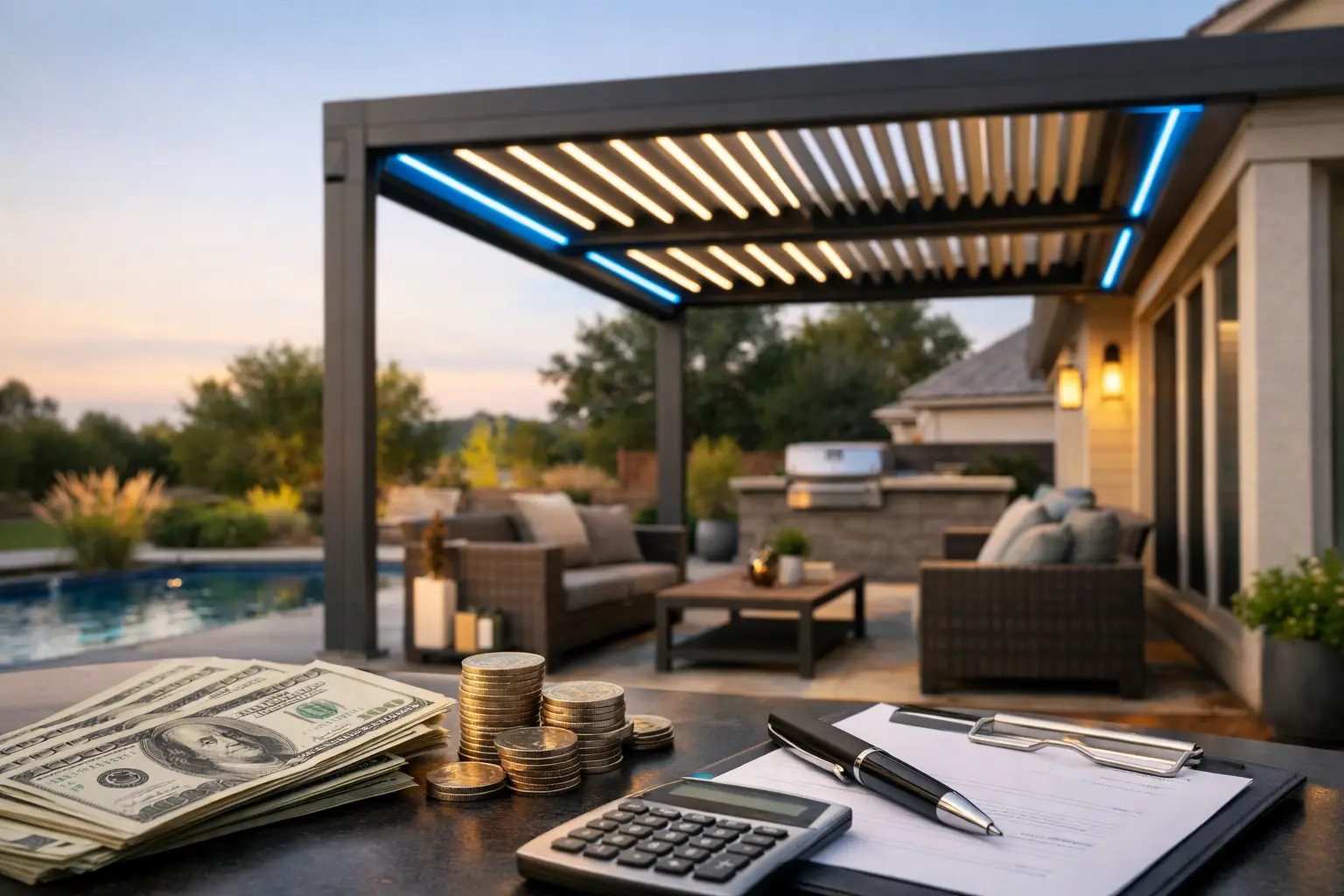
The price gap between a basic patio cover and a fully engineered outdoor living system can be significant – and that is exactly why financing options for backyard pergola projects deserve a closer look before you sign a contract. For many Florida homeowners, this is not an impulse purchase. It is a capital improvement that affects comfort, storm resilience, entertaining, and long-term property value.
A premium pergola project often includes more than the structure itself. Design work, permitting, professional installation, integrated lighting, motorized louvers, and optional shades all shape the final investment. When the goal is a polished, code-conscious result that performs well in heat, rain, and coastal weather, financing becomes less about stretching for a luxury and more about choosing the right way to pay for a serious home upgrade.
Why financing matters on a pergola project
The wrong financing choice can make a strong project feel expensive. The right one can preserve liquidity, keep monthly payments predictable, and allow you to complete the project at the level you actually want rather than cutting back on features you will wish you had later.
That matters even more in Florida, where outdoor structures are not just decorative. Homeowners are often balancing appearance with engineering, wind performance, and longevity. A pergola that is designed as a true extension of the home deserves the same financial planning you would give a kitchen renovation or pool upgrade.
Financing options for backyard pergola projects
There is no single best answer for every household. The ideal financing path depends on how quickly you want to move, how much equity you have, whether you prefer fixed payments, and how strongly you want to protect cash reserves.
Contractor financing
For many homeowners, contractor-arranged financing is the most direct option. It is simple, familiar, and often aligned with the project timeline. Instead of securing funds separately and then finding a builder, you work through the design and approval process while reviewing payment options tied to the project.
The major advantage is convenience. You can compare monthly payment structures early, which helps you decide whether to add premium features such as motorized louvers or lighting from the start rather than revisiting them later. It can also create a smoother experience if you value a concierge-style process.
The trade-off is that convenience does not always mean the lowest borrowing cost. Rates, terms, and promotional periods vary widely. You want clarity on whether the payment is fixed, whether there is a deferred-interest provision, and whether paying the balance early triggers any fees.
Home equity loan
A home equity loan is often attractive for substantial pergola investments because it typically provides a fixed amount at a fixed rate. If you know your project scope and want stable monthly payments, this can be a disciplined choice.
It is especially relevant for homeowners who have built meaningful equity and want to finance the pergola as part of a broader property improvement strategy. Predictability is the benefit here. You know the loan amount, the repayment term, and the payment schedule from day one.
The downside is timing and paperwork. Approval can take longer than contractor financing or an unsecured personal loan. You are also borrowing against the home, which may feel appropriate for a permanent improvement but still deserves thoughtful review.
Home equity line of credit
A HELOC gives you flexibility rather than a lump sum. That can work well if your project may evolve during the planning phase or if you are bundling the pergola with adjacent outdoor upgrades, such as decking, hardscape adjustments, or poolside enhancements.
This option is useful when you want access to funds without borrowing the full amount immediately. You draw what you need and may have lower initial costs. For homeowners who like financial flexibility, that can be appealing.
The catch is that HELOCs often carry variable rates. If rates move higher, your payment can change. That uncertainty may not suit buyers who want a clean, fixed-cost structure.
Personal loan
A personal loan can make sense if you want speed, simplicity, and no lien against the home. Many borrowers like the fact that approval can be relatively fast and the repayment term is usually straightforward.
This tends to work best for mid-range project budgets or for homeowners with strong credit who want to keep mortgage-related financing untouched. It is also a practical option if the project timeline is tight and you do not want to wait for an equity product to close.
The trade-off is cost. Personal loans often come with higher interest rates than home equity products, especially for larger balances. For a premium pergola system, that difference can be meaningful over time.
Cash payment
Paying in cash is still financing in a sense – you are choosing to fund the project from existing assets. For some homeowners, that is the cleanest path. There is no loan application, no interest expense, and no monthly obligation after installation.
But cash is not automatically the smartest move. If using cash would significantly reduce reserves you prefer to keep for market opportunities, travel, property maintenance, or family planning, financing may actually be the more strategic decision. High-net-worth homeowners often finance selectively not because they need to, but because preserving liquidity has value.
How to compare pergola financing beyond the rate
Interest rate matters, but it should not be the only factor guiding the decision. The more useful question is what the financing allows you to do without compromising comfort or confidence.
Start with the monthly payment, but do not stop there. Look at total cost over the life of the loan, any origination fees, prepayment penalties, and whether the payment structure changes after an introductory period. A low early payment can become much less attractive if the terms shift sharply later.
You should also match the financing term to the expected life and value of the project. A high-performance aluminum pergola system with strong engineering and long warranty coverage is not comparable to a temporary backyard purchase. The payment structure should reflect that you are investing in a durable, professionally installed improvement.
When financing is a smart choice
There is a tendency to treat financing as a fallback. For premium outdoor living projects, that is too narrow a view. Financing can be the right move when it helps you complete the project correctly, maintain emergency reserves, or move forward before another season of heat and rain limits your use of the space.
It can also be smart when you do not want to reduce the scope to meet an arbitrary cash number. Homeowners often regret trimming the features that shape everyday experience most – adjustability, lighting, and shade control tend to fall into that category. If financing allows you to build the pergola you actually want rather than a compromised version, that can be a rational decision.
This is particularly true in coastal and hurricane-prone areas, where engineering quality is not a cosmetic upgrade. A professionally designed, hurricane-rated structure with clear warranty protection delivers a different level of long-term confidence than a lower-spec alternative.
Questions to ask before you choose financing options for backyard pergola projects
Before you commit, ask a few practical questions. Is the payment comfortably within your monthly budget even if other home expenses rise? Does the lender allow early payoff without penalty? Are you financing only the pergola, or the full outdoor living plan around it?
You should also ask how the builder handles pricing, deposits, change orders, and project timing. Transparent communication matters. A well-run pergola company should be able to explain not only what the project costs, but when costs are due and how financing aligns with design, permitting, and installation milestones.
For Florida homeowners, another smart question is whether the structure you are financing is genuinely engineered for local conditions. Premium pricing only makes sense when it is backed by meaningful performance, warranty strength, and professional execution.
The best choice is the one that supports the right project
A backyard pergola is easy to frame as a lifestyle purchase, but in the right setting it is also a practical investment in how the home functions every day. It can add usable square footage outdoors, improve comfort around a pool or lanai, and create a more refined setting for entertaining throughout the year.
That is why the best financing decision is not always the cheapest rate on paper. It is the option that gives you confidence in the full project – design, engineering, installation, and long-term ownership. If you are comparing proposals from a premium builder such as enVision Pergola, the conversation should be about more than price alone. It should be about how to move forward without cutting corners on the features, performance, and protection that made the project worth doing in the first place.
A well-chosen financing plan should make the decision feel clearer, not more complicated.