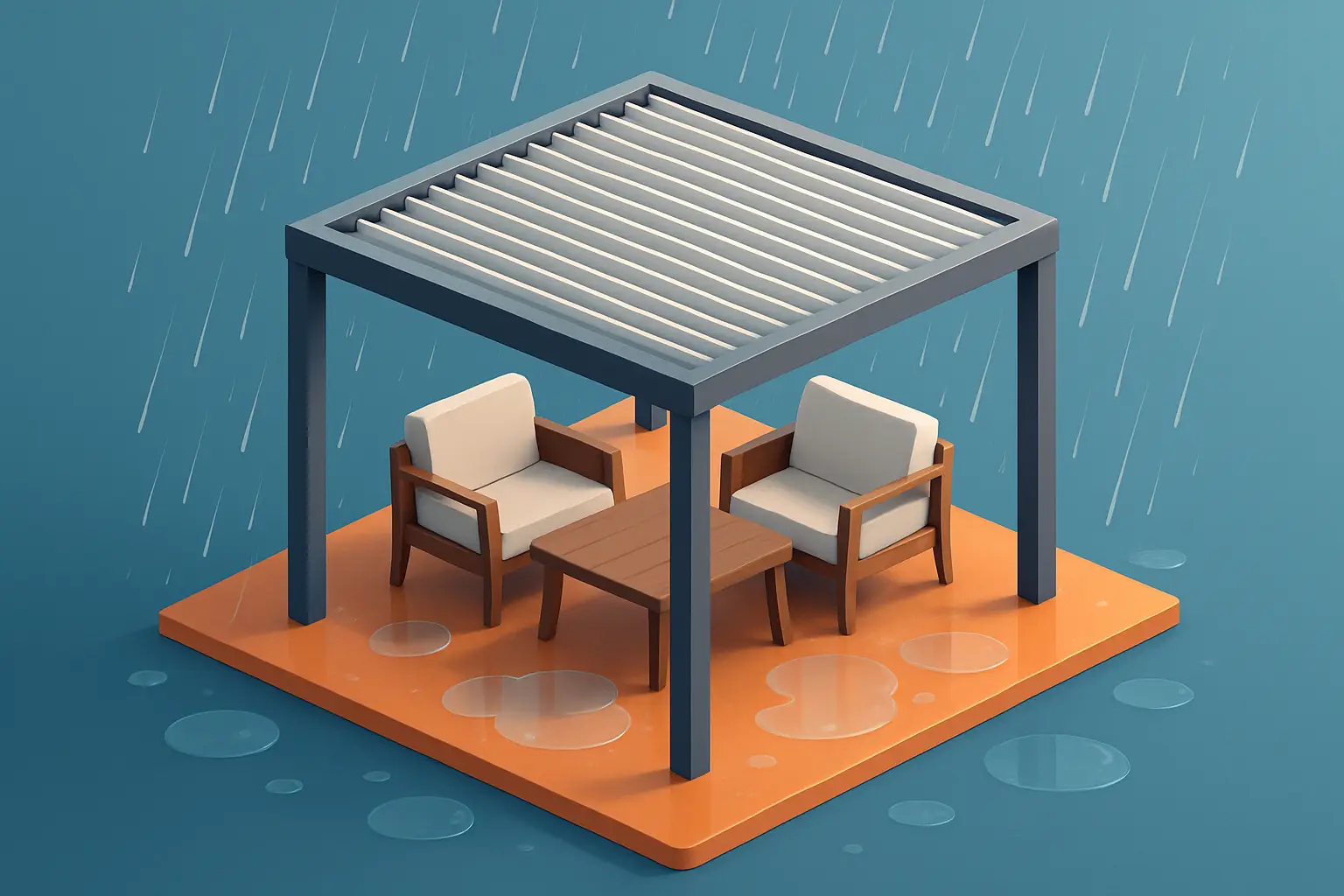
You plan a weekend dinner outside. The sky does that familiar Florida shift from bright to bruised in about 90 seconds. The question becomes very simple, very fast: will your pergola keep the table dry – or are you about to sprint for the sliders?
Are louvered pergolas waterproof in rain?
The honest answer is: a quality louvered pergola can be effectively waterproof when the louvers are fully closed, properly pitched, and paired with an engineered gutter and drainage system. But “waterproof” depends on rain intensity, wind direction, installation details, and whether the roof is truly designed to manage water – not just block sun.
Homeowners often hear “rainproof” or “weather resistant” thrown around. Those phrases can mean anything from “it helps a little” to “you can keep furniture under it in a downpour.” If you live in Florida, you do not want vague. You want to know what happens in real rain, with real wind, on a real patio.
What “waterproof” actually means outdoors
Waterproof does not mean your outdoor space becomes an indoor room. It means water is controlled and directed.
With a well-built louvered system, the goal is to close the roof, shed rainfall across the louvers, move that water into perimeter gutters, and then send it down internal drains or downspouts away from the living area. When all of those pieces are present and correctly installed, most rain events can be handled cleanly.
Where the word “waterproof” can become misleading is at the edges and in wind-driven conditions. Even the best systems can experience some misting, splash, or light intrusion if wind pushes rain sideways or if runoff hits the deck and rebounds.
How louvered roofs shed water (and where the water goes)
A motorized louvered pergola roof is not a flat pan. Each louver overlaps like a series of blades that rotate to open for ventilation or close to form a continuous surface.
When closed, the louvers are designed to interlock. That interlock is the first line of defense against leaks. The second line of defense is geometry – a slight pitch that encourages water to move in a predictable direction.
From there, the water management system matters as much as the louvers themselves. A true architectural-grade system routes water into built-in gutters along the frame. Those gutters then channel water into internal posts (or designated downspouts) and discharge it at the base, typically away from the foundation and high-traffic zones.
If you are comparing pergolas, ask a very specific question: when the louvers are closed, where does the water go? If the answer is unclear, you are looking at a shade structure, not a rain-managing roof.
The Florida factor: wind-driven rain changes everything
Florida rain is rarely polite. In summer, storms can dump inches quickly. Along the coast, rain often arrives with gusts that turn “vertical rainfall” into a sideways pressure test.
This is why two homeowners can buy “louvered pergolas” and have totally different experiences. In calm rain, most decent systems keep the space dry beneath. In wind-driven rain, water can be pushed through tiny tolerances, carried under the edges, or blown into the space from open sides.
That does not mean a louvered pergola fails. It means your expectations should match physics. A louvered roof blocks and drains water from above. It cannot seal the entire perimeter of an outdoor room unless you add side protection, such as automated shades or fixed walls.
What determines whether your pergola stays dry
1) Louver design and interlock quality
Not all louvers close the same. Precision matters. Higher-end systems use tighter manufacturing tolerances and better seals where louvers meet. That affects how much water can migrate through under pressure.
Also consider how the louvers handle pooling. A well-engineered louver profile directs water toward the gutter path rather than letting it sit.
2) Integrated gutters and internal drainage
This is the big one. If a pergola lacks an integrated drainage system, water will simply run off the edges – often exactly where you do not want it, like onto seating or across door thresholds.
With integrated gutters and internal drains, water is collected and controlled. That is the difference between “we can stay out here” and “we have to move everything to the center.”
3) Installation and pitch
Even the best pergola can perform poorly if it is installed out of level, pitched incorrectly, or attached without proper flashing where it meets the home.
In Florida, installation quality is not a minor detail. It is the difference between a clean, quiet rain event and constant drips at one corner because water is not being guided into the drainage path.
4) Wind rating and structural rigidity
Waterproofing is not just about water. In storms, deflection matters. A frame that flexes under gusts can change tolerances between louvers and introduce gaps. A hurricane-rated, rigid structure holds alignment better during the exact moments you need it most.
5) The space under the pergola
Your surface and layout influence perceived “waterproofing.” A textured paver deck can splash more than a smooth slab. Furniture placement matters too – right under a discharge point is a recipe for frustration.
Common “leak” moments that are normal (and fixable)
A few scenarios show up repeatedly in real backyards.
Light dripping can occur right after you open the louvers following a storm. Water sits in the gutter system and on the louver edges. When the roof rotates, that water releases. It is not a leak during rain, but it can surprise first-time owners.
Splashback is another. Even when the roof drains perfectly, heavy rain hitting the ground near the perimeter can rebound into the covered zone. This is where adding a side shade on the windward side can make the space feel dramatically drier.
And then there is the “tropical sheet rain plus 25 mph gusts” situation. In that moment, you are asking an outdoor structure to behave like a sealed roof assembly. A premium louvered pergola will outperform basic options, but some misting at the edges can still happen when the storm is essentially horizontal.
Louvered pergolas vs. solid roof covers in rain
A solid roof patio cover behaves more like a traditional roof. It typically offers the best raw rain-blocking overhead, especially in wind, because there are fewer joints.
The trade-off is control. A solid roof locks you into permanent shade, less airflow, and a heavier visual mass that can darken adjacent interior rooms.
Louvered pergolas sit in the luxury middle: you get sun when you want it, ventilation when you need it, and rain protection on demand – assuming you choose a system engineered for drainage and installed correctly.
For many Florida homeowners, that flexibility is the point. You are not buying a roof. You are buying control.
What to look for if “waterproof in rain” is a must-have
If your non-negotiable is staying dry enough to keep cushions outside and continue a conversation during most storms, focus on engineering details, not marketing terms.
Look for a motorized louver system with a proven interlocking roof, integrated gutters, internal drainage, and warranty coverage that reflects confidence in the structure and moving parts. Also ask how the design handles your specific site: roofline tie-ins, slab slope, prevailing wind direction, and where the downspouts will discharge.
This is also where a builder’s local experience matters. Florida installs are not theoretical. They are tested by sudden storms, salty air, and hurricane-season realities.
If you want a system engineered for Florida extremes, enVision Pergola designs and installs architectural-grade, hurricane-rated louvered pergolas with motorized control and integrated drainage, backed by long-term warranty coverage.
Practical expectations: what you can comfortably do in the rain
With a well-designed louvered pergola fully closed, most homeowners can keep dining and lounge areas dry in typical rain, and the space feels usable for day-to-day weather changes.
During heavy wind-driven storms, comfort depends on your layout. If you have open sides facing the wind, rain can travel under the perimeter. Add automated shades or wind screens on the exposed sides and the space behaves far closer to an outdoor room.
In other words: the roof handles “rain from above.” If you also want protection from “rain from the side,” design the enclosure thoughtfully.
The closing thought
If your pergola is meant to be a true extension of your home – not a fair-weather accessory – treat “waterproof” as a system question, not a single feature. The best outcomes come from engineering plus installation plus a design that respects Florida’s wind and water, so you are not staring at the forecast before you set the table.