
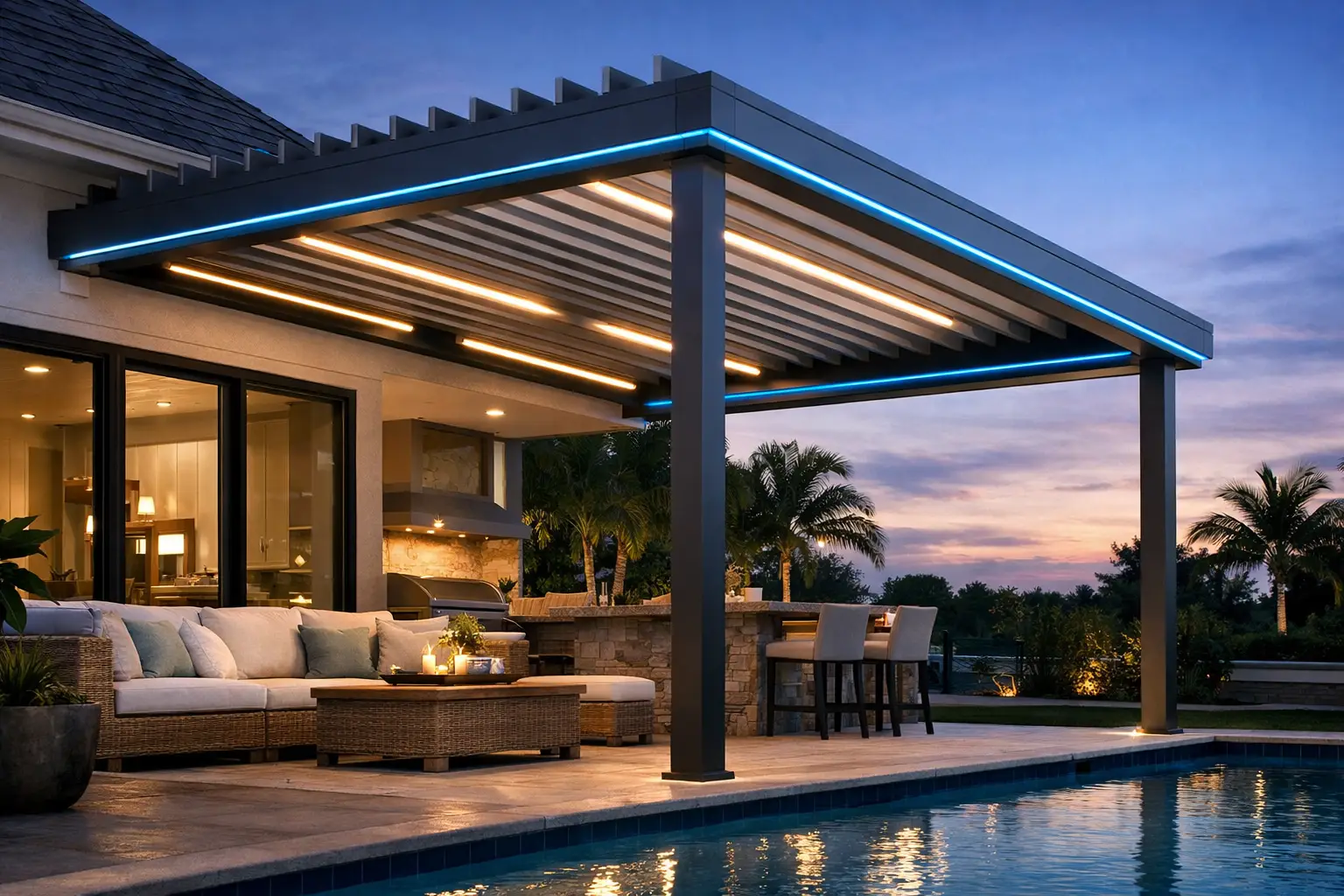
A lanai can be the best square footage in a Florida home – right up until the sun becomes relentless, the rain moves in sideways, or the space feels too exposed to use comfortably. That is where custom pergola design for lanais stops being a decorative upgrade and starts becoming a practical architectural decision.
For homeowners investing in a true outdoor living space, the question is not whether a pergola looks good. It is whether it belongs to the house, performs in Florida weather, and creates daily comfort without constant compromise. The right lanai pergola should do all three.
Why custom pergola design for lanais matters
A lanai is different from an open patio or freestanding poolside structure. It usually sits close to the home, often under a roofline transition, near large glass openings, outdoor kitchens, or screened enclosures. That means the pergola has to work with the architecture, not compete with it.
Custom design matters because every lanai has fixed conditions. Roof heights vary. Sightlines into the backyard or pool may need to stay open. Drainage cannot be an afterthought. If the home has a contemporary elevation, a heavy-looking structure can feel out of place. If the property sits in a coastal wind zone, appearance alone is not enough.
This is also where many homeowners start to see the difference between a basic shade feature and a premium outdoor system. A well-designed pergola can control sun exposure, manage rain, support lighting, and create a more finished transition between the interior and exterior of the home. On a high-value property, that level of integration is what makes the project feel intentional.
Start with how the lanai will actually be used
The best design conversations begin with lifestyle, not dimensions. A lanai used for quiet morning coffee needs a different approach than one designed for evening entertaining, outdoor dining, or weekend family gatherings.
If the space faces west, late-day heat may be the driving issue. If it sits near a pool, glare and reflected light might matter more than overhead shade alone. If the lanai includes a grill or full outdoor kitchen, ventilation, clearances, and moisture resistance become more important. For some homeowners, privacy is part of comfort, which is where integrated side shades can add real value.
This is why one-size-fits-all layouts tend to disappoint. The most successful pergola designs are tailored to how the homeowner wants the space to feel at 10 a.m., 3 p.m., and after sunset.
Design priorities that separate premium projects from average ones
Luxury lanai design is often about restraint. The pergola should add presence without making the rear elevation feel crowded or top-heavy. Proportion matters. So does alignment.
Posts should relate cleanly to columns, door openings, and major architectural lines. The beam depth should suit the scale of the house. Louvers, lighting, and trim details should feel deliberate, not layered on after the fact. On larger homes, a pergola can help organize outdoor zones, creating a dining area, lounge space, or transition to the pool deck without breaking visual flow.
There is also a practical side to premium design. Integrated lighting should be planned early so it supports evening use without harsh glare. Motorized louvers should be positioned to maximize control of sun and rain based on the lanai orientation. Drainage needs to move water away efficiently, especially where the pergola connects near doors, sliders, or finished hardscape.
Done well, the pergola feels less like an accessory and more like an extension of the home’s original architecture.
Materials and engineering are not secondary decisions
In Florida, material selection is inseparable from performance. A lanai structure has to hold its appearance, resist corrosion, and perform under demanding weather conditions. For luxury homeowners, maintenance also matters. The outdoor space should enhance the property, not create a new cycle of upkeep.
That is why architectural-grade aluminum has become the preferred choice for high-end pergola systems. It delivers a clean, modern profile while supporting advanced features like motorized louvers, integrated lighting, and automated shades. More importantly, it aligns with what Florida homeowners actually need – durability, structural reliability, and long-term value.
Engineering deserves equal attention. A pergola attached to or positioned alongside a lanai is not simply a visual frame. It is a structural system that must be designed for local codes, site conditions, and wind exposure. In coastal and hurricane-prone areas, that level of engineering is not a luxury. It is the baseline for peace of mind.
Homeowners in places like Boca Raton, Naples, Tampa, and other storm-exposed Florida markets are right to ask hard questions about wind ratings, permitting, and installation standards. Premium outdoor living is more enjoyable when it is backed by real performance.
Custom pergola design for lanais with motorized control
One of the biggest shifts in outdoor living design is the expectation of control. Homeowners do not want to accept full sun at noon and full exposure when an afternoon shower arrives. They want the space to adapt.
Motorized louvered pergolas answer that need exceptionally well on lanais. With the touch of a button, the overhead environment can shift from open sky to filtered shade to rain protection. That flexibility makes the lanai usable far more often throughout the year.
For entertaining, it is especially valuable. You can host dinner with ambient lighting overhead, open the louvers for airflow when the evening is mild, or close them when weather changes quickly. If the lanai faces intense seasonal sun, automated shades can help control brightness and heat along the perimeter without closing the space off completely.
There is a trade-off, of course. More capability means more design coordination upfront. Power planning, drainage strategy, and feature integration need to be resolved before installation begins. But for homeowners seeking a true outdoor room rather than a simple shade element, that planning is exactly what produces the better result.
The permit and installation process should feel organized
Luxury clients usually care about the final look, but they care just as much about how the project is handled. A premium pergola experience is not only about product quality. It is also about communication, timeline clarity, and confidence that the build process is being managed correctly.
That starts with design development grounded in the home’s architecture and the site’s conditions. From there, permit requirements, engineering documentation, and installation sequencing need to be handled with precision. On lanais, this is particularly important because the pergola often sits in close relationship to the house, existing finishes, and other outdoor investments.
A poorly managed install can disrupt hardscape, interfere with drainage, or leave awkward transitions at the home connection points. A well-managed one feels measured and professional from estimate through completion. For homeowners investing at a premium level, that concierge-style process is not a bonus feature. It is part of the value.
What homeowners should ask before moving forward
If you are evaluating pergola options for a lanai, ask questions that go beyond appearance. Ask how the system is engineered for Florida wind conditions. Ask whether drainage is integrated into the design. Ask how lighting and shades are coordinated. Ask what warranties protect the structure and the moving components. And ask who is responsible for permits, installation, and final fit.
Those answers tell you a great deal about the quality of the company and the long-term ownership experience. A beautiful pergola that lacks serious engineering or clear project management can become an expensive compromise.
By contrast, a properly designed system gives you what most homeowners really want from the start – more usable time outside, a cleaner architectural finish, and confidence that the investment is built for Florida rather than merely placed in it.
For homeowners who want that level of performance, enVision Pergola approaches custom design as both an aesthetic and engineering exercise, with hurricane-rated systems, integrated features, and a consultative process built around clear expectations.
A lanai should feel like a luxury extension of the home, not a space you avoid during the hottest or wettest parts of the day. When the pergola is custom designed around the way you live, the architecture you own, and the weather you actually face, the result is not just better shade. It is a better way to use your home.