
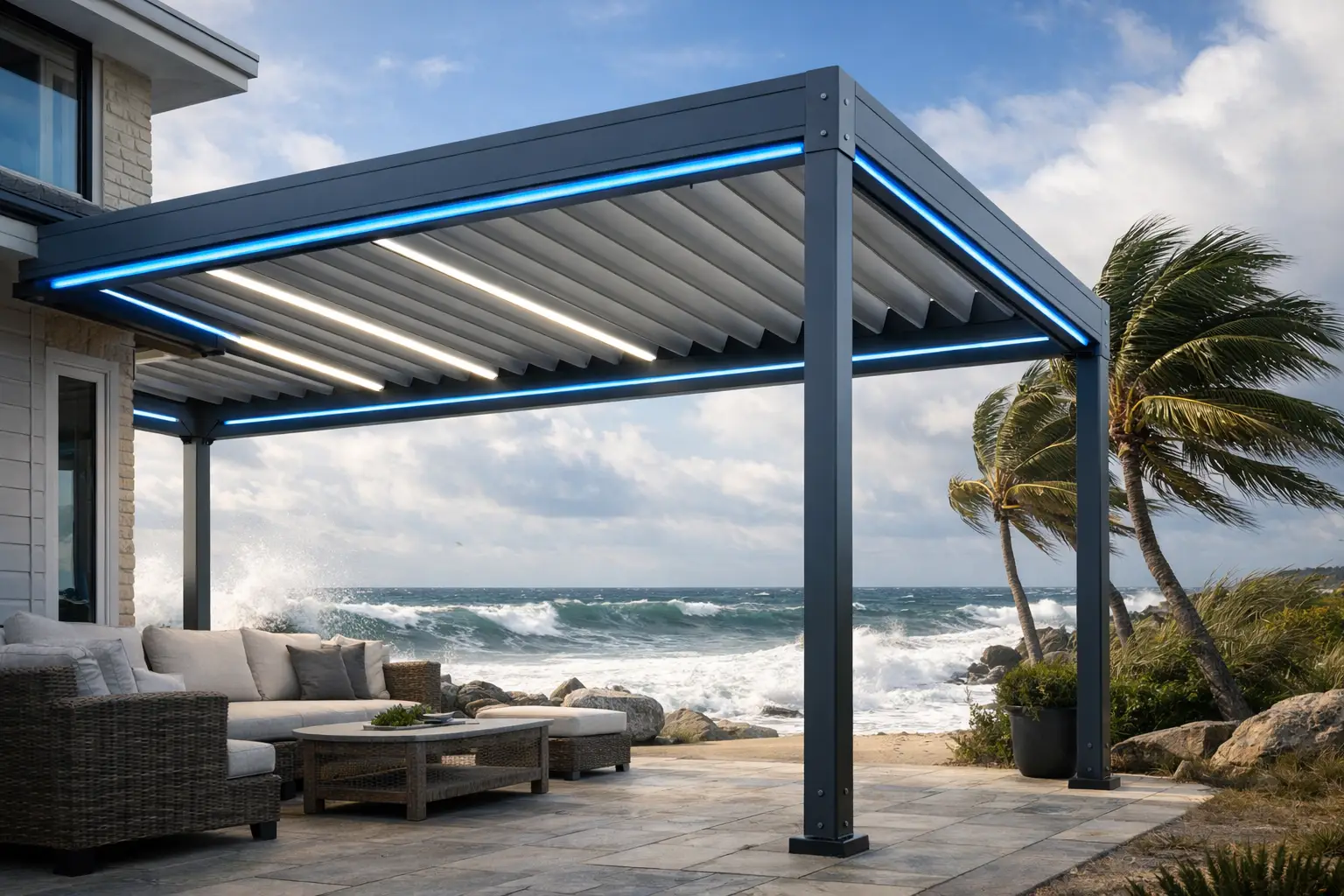
A pergola near the coast is not judged on a calm afternoon. It is judged when wind starts pressing laterally across an open patio, uplift begins working at the roof plane, and every connection in the structure is forced to do its job at once. That is why pergola anchoring methods for coastal wind deserve far more attention than finish colors, lighting layouts, or even louver options. In Florida, the anchor strategy is not a detail. It is the foundation of whether a pergola performs like a permanent architectural addition or behaves like a liability.
For homeowners investing in a high-end outdoor living space, that distinction matters. A luxury pergola should feel elegant every day and engineered when conditions turn serious. The right anchoring approach protects the structure, preserves the surrounding hardscape, and supports the long-term value of the installation.
Why pergola anchoring methods for coastal wind matter more at the shoreline
Coastal wind is different from the occasional strong gust inland. Exposure is often broader, wind speeds can escalate quickly, and salt-rich air adds another layer of stress by attacking lower-grade metals over time. A pergola in Boca Raton, Naples, or on a barrier island site faces a very different design conversation than one in a sheltered interior backyard.
Wind does not only push from the side. It can lift upward, rack the frame diagonally, and exploit weak points at the base plate, bolts, footings, and attachment points. A pergola may look substantial, but if the load path is not engineered from the roof system down into the foundation, appearance means very little. The key question is simple: where do the forces go, and is every connection designed to transfer them safely into the ground?
That is why experienced builders start with engineering, permitting, and site conditions before discussing aesthetics. On coastal properties, the anchor plan is often one of the most consequential parts of the entire build.
The real load path starts below the surface
When homeowners hear “anchoring,” they often picture a few heavy bolts at the base of each post. In reality, those bolts are only one part of a much larger system. Effective pergola anchoring methods for coastal wind depend on a continuous load path that begins at the top structure and ends in properly designed concrete footings or structural substrates.
If any part of that chain is undersized, incompatible, or poorly installed, the assembly becomes vulnerable. A premium pergola should never rely on cosmetic mass or assumptions about weight alone. Dead load helps, but it does not replace engineering.
Footings are usually the deciding factor
In many coastal installations, the footing design is what separates a code-compliant pergola from one that simply appears secure. Properly sized concrete footings resist overturning, uplift, and lateral forces. Depth, diameter, reinforcement, and soil conditions all matter.
A small decorative slab may not provide the structural resistance needed for hurricane-prone regions. In some cases, an existing patio surface is adequate only as a finish surface, not as the true structural base. That means sections may need to be cut, excavated, and rebuilt to create engineered footing locations below the visible hardscape.
This is one reason turnkey design-build service matters. The best outcome often requires coordination between engineering, permitting, fabrication, and installation rather than improvising at the job site.
Surface mounting can work, but only when the substrate is truly structural
Some pergolas are surface-mounted to existing concrete, elevated decks, or structural foundations. This can be appropriate, but only if the underlying structure has the thickness, reinforcement, and condition to accept the loads. A beautiful pool deck is not automatically a structural anchoring surface.
This is where coastal projects require discipline. If the slab is too thin, cracked, unreinforced, or isolated from proper footings, simply adding stronger bolts will not solve the problem. Strong hardware installed into a weak substrate still produces a weak installation.
Common anchoring approaches and where each fits
Not every site needs the same anchor design, and that is exactly the point. Good builders do not force one standard detail onto every property.
Embedded anchors in new concrete
For new builds or major patio reconstruction, embedded anchoring into freshly poured concrete is often one of the strongest options. This approach allows the footing, reinforcement, and anchor placement to be designed together from the beginning. Tolerances can be controlled more precisely, and the structure benefits from a more intentional foundation system.
For custom aluminum pergolas in exposed coastal settings, this method often delivers the cleanest combination of strength and longevity.
Mechanical anchors into existing concrete
Mechanical anchoring can be effective when the existing concrete is structurally sound and properly engineered. The exact anchor type, embedment depth, edge distance, and spacing must match the load requirements and the concrete conditions.
This is not a one-size-fits-all decision. The wrong anchor in the right slab can fail. The right anchor in the wrong slab can also fail. Coastal installations require a measured approach that accounts for both hardware performance and the structure beneath it.
Epoxy-set anchoring systems
In some conditions, adhesive or epoxy-set anchors are used to achieve high-capacity connections in existing concrete. These systems can perform very well when specified correctly and installed with strict attention to hole preparation, curing time, and environmental conditions.
They are not a shortcut. On the coast, temperature, moisture, and installation accuracy all affect performance. That makes installer discipline just as important as product selection.
Hardware selection is not the place to save money
Salt air is relentless. Even when corrosion is not immediately visible, it can gradually compromise fasteners and connectors that were never meant for a coastal environment. That is why material specification matters.
Stainless steel and other corrosion-resistant components are often preferred in coastal applications, particularly at critical connections. Coated fasteners may be suitable in some conditions, but “suitable” and “best for a luxury, long-term installation near the water” are not always the same thing. It depends on exposure, proximity to salt spray, maintenance expectations, and engineering requirements.
Higher-grade hardware costs more up front. It also helps protect a much larger investment. For a premium pergola system, that trade-off is usually easy to justify.
Engineering, code, and permitting are part of the anchoring method
In Florida, the anchoring conversation is not separate from code compliance. Wind exposure category, local jurisdiction requirements, site geometry, and product engineering all influence what is acceptable. A pergola that performs well on paper still has to be permitted and installed to the approved plans.
That is especially important for homeowners who want confidence, not guesswork. Professionally engineered systems with documented wind ratings offer a very different level of assurance than generic outdoor structures assembled with off-the-shelf assumptions.
For coastal homes, the best builders approach anchoring as a documented engineering solution, not a field decision. That includes site review, structural calculations where required, permit coordination, and installation methods aligned with approved details.
Design choices can change the anchor requirements
Pergola anchoring is not decided in isolation. The size of the structure, post spacing, height, roof configuration, integrated shades, and attachment style all affect the loads moving through the frame.
A larger louvered pergola with motorized components may impose different demands than a simpler open-roof structure. Likewise, a freestanding pergola can behave differently from one attached to the home. Attached installations may benefit from support at the building connection, but they also require careful integration with the house structure and envelope.
This is where premium design and engineering should work together. Homeowners should not have to choose between refined architecture and serious performance. The best result is a pergola that looks tailored to the property because its structural strategy was considered from the start.
What homeowners should ask before approving a coastal pergola installation
A strong proposal should explain how the pergola is being anchored, what substrate or footing it relies on, and whether the system is engineered for the specific site conditions. If those answers stay vague, that is a concern.
It is reasonable to ask whether new footings are required, whether the existing slab is structurally adequate, what corrosion-resistant hardware is being used, and how wind loads are addressed in the permit package. Homeowners investing in a luxury outdoor structure should expect precise answers, not sales language standing in for engineering.
A qualified contractor should also be transparent about trade-offs. Sometimes the most efficient installation method is not the strongest long-term method for a coastal property. Sometimes preserving an existing deck layout means accepting construction complexity beneath the surface. Those are worthwhile conversations when the goal is lasting performance.
At enVision Pergola, that engineering-first approach is central to how premium outdoor spaces are delivered across Florida’s coastal markets. For homeowners who want a pergola to function as a true extension of the home, the anchor strategy should feel just as considered as the architecture above it.
The best pergola does not prove itself in the showroom. It proves itself years later, after sun, salt, and storm seasons have all had their turn.