
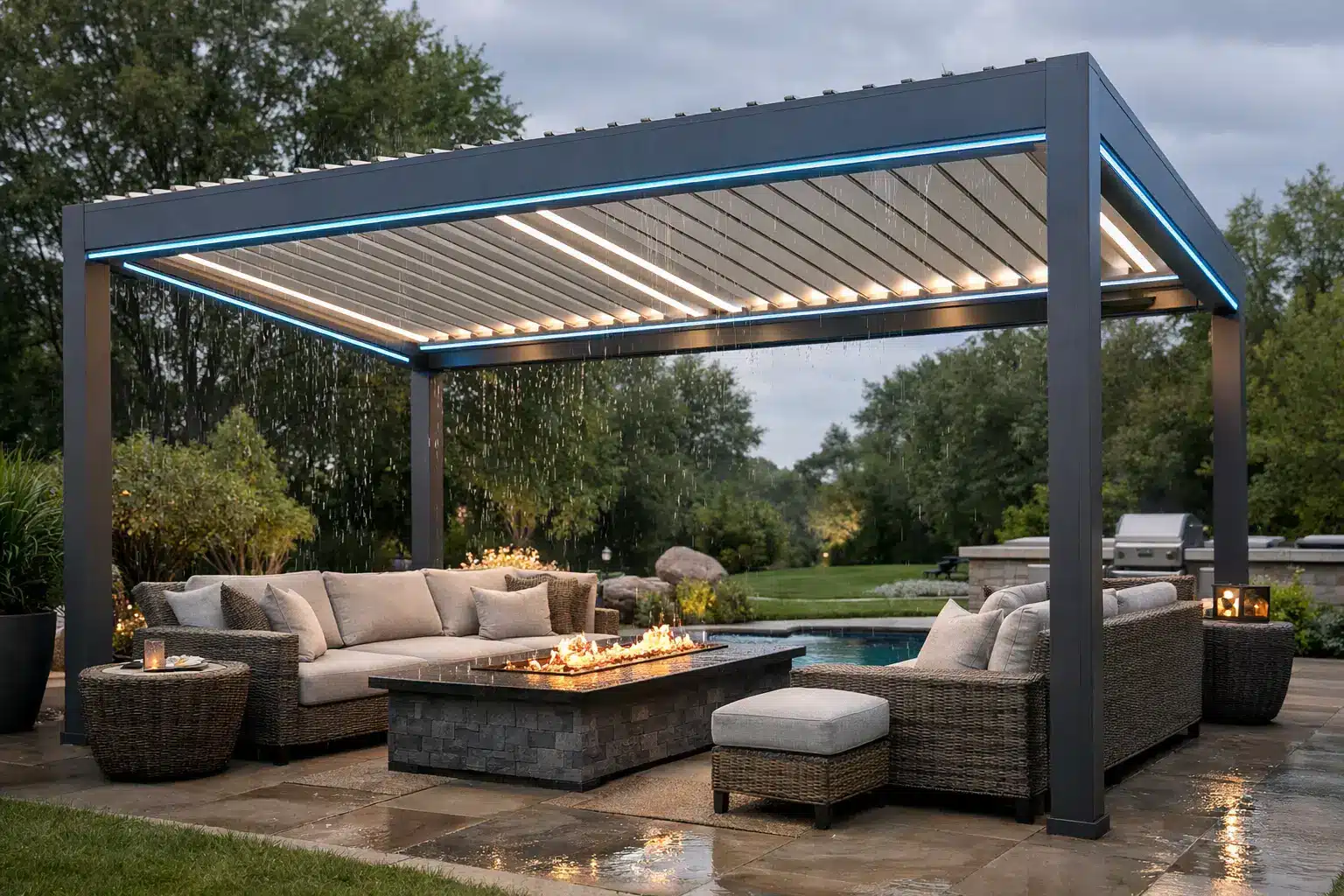
A Florida afternoon can turn from bright and calm to rain-soaked before guests have finished their first drink. Proper rain sensor louvered pergola settings are what make that change feel managed rather than disruptive. When configured correctly, the system detects rainfall, closes the motorized louvers, and helps preserve the comfort of your patio, pool deck, or outdoor dining area without requiring someone to reach for a remote.
For a luxury outdoor living space, automation should support the way you actually use it. The goal is not simply to close the roof whenever a few drops fall. It is to balance fast weather response, effective water management, daily usability, and the specific conditions around your home.
What a Rain Sensor Actually Controls
A rain sensor detects moisture on its surface and sends a signal to the pergola control system. Depending on the system and its programming, that signal can command the louvers to rotate to their rain-closure position. In a properly designed aluminum pergola, the closed louvers direct water into integrated gutters and downspouts rather than allowing it to spill through the roofline.
That distinction matters. A rain sensor is not a weather station, and it is not a substitute for a hurricane preparation plan. It is a convenience and comfort feature designed to respond to rain. Wind conditions, power interruptions, and severe-storm procedures must be handled according to the pergola system’s engineering requirements and your installer’s guidance.
The quality of the overall installation matters as much as the sensor itself. Sensor placement, roof pitch, drainage routing, electrical connections, and control programming all affect how reliably the pergola responds when weather moves in.
Rain Sensor Louvered Pergola Settings to Prioritize
The best settings are rarely one-size-fits-all. A covered outdoor kitchen has different priorities than a poolside lounge, and a property exposed to coastal wind and driving rain needs a different approach than a sheltered courtyard. Still, three settings deserve careful attention during installation and handoff.
Rain sensitivity
Sensitivity determines how much moisture the sensor needs to detect before it initiates closure. Set too sensitive, a sensor may react to heavy dew, irrigation overspray, or a brief misting event. Set too low, it may wait longer than you would like during a fast-moving shower.
For many Florida homeowners, a moderate starting point is practical. It allows the sensor to react to meaningful rainfall while reducing nuisance closures. If your pergola sits near landscape irrigation or a pool with frequent splashing, this setting becomes especially important. Your installer can help determine whether the sensor location or sensitivity needs adjustment after you have lived with the system for a few weeks.
Closure delay
Some control systems allow a delay before the louvers move after rain is detected. This can be useful in climates where a few isolated drops are common, but it is usually not the right place to over-optimize for Florida weather. A long delay may keep the roof open during exactly the kind of sudden downpour that leaves cushions, dining settings, and outdoor finishes exposed.
A short delay is generally the better choice for an entertaining area. It gives the sensor a moment to confirm rainfall without sacrificing the primary benefit of automation: prompt protection when the weather changes unexpectedly.
Dry-out or reopening behavior
Automatic closure is only half of the equation. After rain stops, some homeowners prefer to reopen the louvers manually so they can decide when to restore light and airflow. Others prefer an automatic reopen function after the sensor has dried for a set period.
Manual reopening offers more control. It prevents the roof from opening while the surrounding patio is still wet, while wind is blowing rain back into the space, or while you are away from the property. Automatic reopening can be convenient, but it should be programmed with enough dry-out time to avoid repeated opening and closing during intermittent showers.
The Rain-Closure Position Is About Drainage, Not Just Shade
A louvered roof does not need to close in the same way it opens for shade. During normal use, louvers may be tilted to provide filtered light, ventilation, or a view of the sky. During rain, they need to move into the designated closed position so water is directed into the system’s integrated drainage channels.
That is why homeowners should not assume that a nearly closed louver position is sufficient during a shower. The exact closure position is determined by the system design. When the sensor activates, the control should send louvers to that intended rain-management position, not simply to the last position used.
At your final walkthrough, ask the installer to demonstrate the rain cycle. You should see how the louvers close, where water exits, and how the control responds once the sensor dries. This is also the time to confirm that downspout discharge is directed away from walkways, doors, and areas where standing water would be inconvenient.
Sensor Placement Can Make or Break Performance
A rain sensor needs an unobstructed location where it can receive rainfall quickly. A placement beneath an overhang, near a dense tree canopy, or in an area shielded by the home may delay detection. Conversely, a location directly in the path of irrigation can cause avoidable activations.
The ideal location is often near the pergola roofline, positioned to experience the same weather conditions as the louvers while remaining accessible for service. It should also be considered as part of the property’s architecture. On a premium outdoor structure, exposed wiring, poorly placed components, and improvised mounting details diminish the finished appearance.
This is one reason a professional design-build process is valuable. The sensor should be planned alongside lighting, shades, controls, drainage, electrical routing, and the pergola’s structural layout, not added as an afterthought.
Plan for the Way You Use the Space
Your preferred settings should reflect what sits beneath the pergola. If the space covers a dining table, upholstered seating, or an outdoor kitchen, rapid closure is usually the priority. If it covers a pool-adjacent sitting area that is already exposed to splashing and open air, you may accept a slightly less sensitive setting to limit activations.
Consider your typical schedule as well. Homeowners who travel seasonally often value automatic rain response because the home may be unoccupied when storms pass through. Homeowners who spend most afternoons on the patio may prefer manual reopening, allowing them to reassess the weather before opening the roof after a shower.
Integrated lighting and automated shades add another layer of coordination. A rain sensor may control louvers independently, while lighting and shades continue to follow their own programmed scenes or wall controls. During commissioning, make sure you understand which functions are automated and which require a manual command. Clear expectations prevent frustration later.
Do Not Treat Rain Automation as Storm Protection
Florida’s weather demands a clear distinction between rain management and extreme-weather readiness. A rain sensor is excellent for responding to ordinary rainfall. It does not evaluate wind speed, detect debris, or make structural decisions for a hurricane-rated pergola.
For a serious weather event, follow the operating instructions provided for your specific system. If your pergola includes automated shades, ask about their required position during high-wind conditions. Review the plan before storm season, not when a named storm is already approaching. Professional installation, proper permitting, engineered anchoring, and a system rated for local conditions are the foundation of confidence, not a single automation setting.
At enVision Pergola, that engineering-first approach is part of the larger value of a custom outdoor structure. The objective is a refined extension of the home that is designed for Florida sun, rain, and demanding conditions, with the craftsmanship and guidance to match.
A Simple Seasonal Check Keeps Automation Reliable
Rain sensors are low-maintenance, but they should not be forgotten. A quick check before the rainy season can prevent surprises when the first major shower arrives. Inspect the sensor surface for accumulated debris, confirm that nearby irrigation is not striking it, and test the closure command while you are present.
Also watch the drainage system during a real rain event at least once after installation. Water should move through the intended channels and discharge cleanly. If you see overflow, dripping in an unexpected location, delayed closure, or repeated false activations, contact your installer rather than attempting to alter wiring or control settings yourself.
The right automation feels almost invisible: the outdoor space stays ready, the roof responds when it should, and you remain in control when conditions call for a personal decision. That is the standard worth setting before the next Florida shower tests your pergola.