
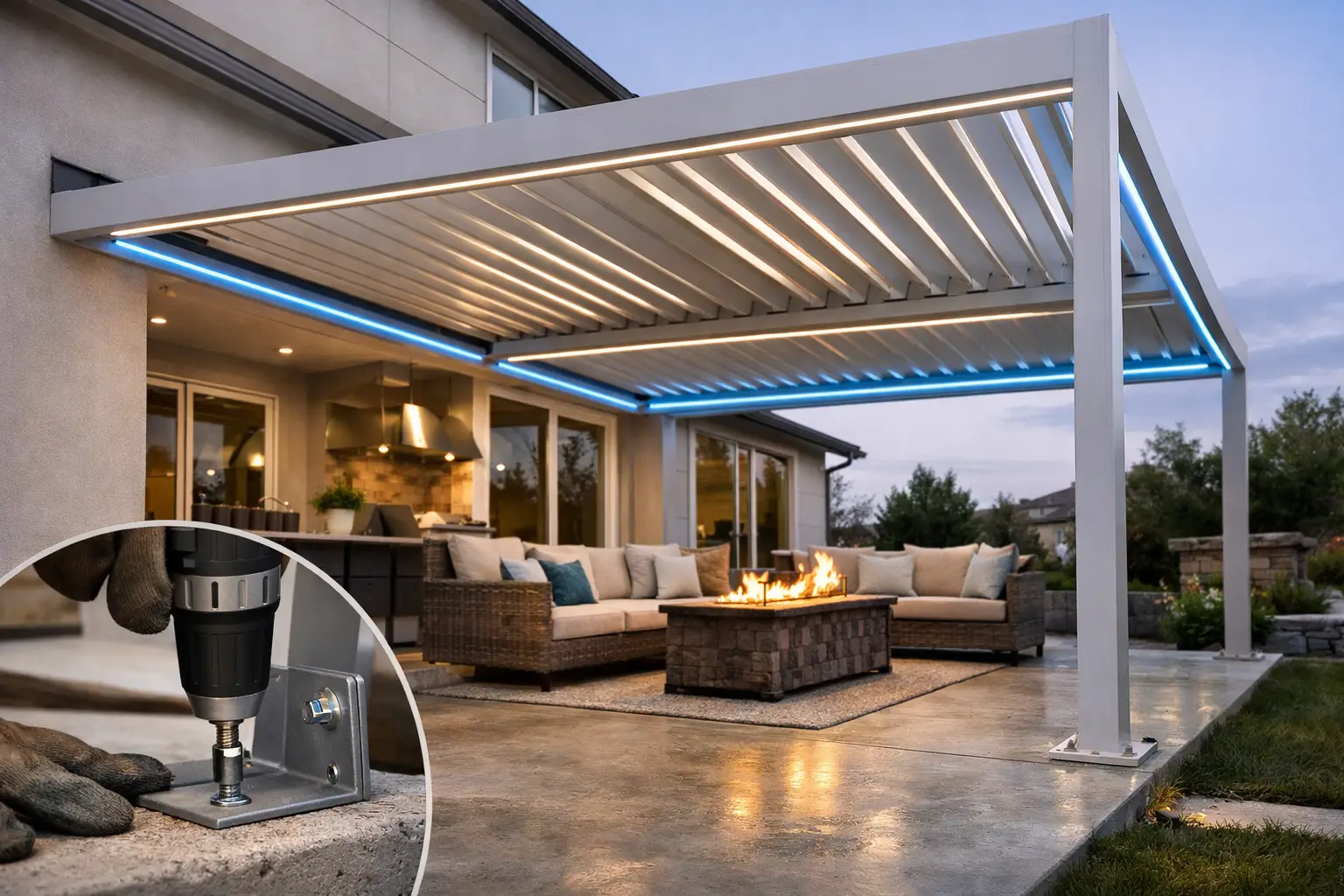
A pergola is only as strong as what holds it to the slab. In Florida, that matters more than most homeowners realize. This guide to attaching pergola to concrete slab covers the part of the project that decides whether your investment feels permanent, performs properly, and stands up to demanding weather.
For a luxury pergola, attachment is not a minor installation detail. It is structural engineering in plain sight. The wrong anchor, the wrong slab thickness, or the wrong placement near an edge can compromise stability, drainage, finish quality, and in some cases code compliance.
Why slab attachment deserves more attention
Many homeowners focus first on style – louvers, lighting, shade, and how the pergola will complement the pool deck or patio. Those details matter, but the base connection is what determines whether the structure can safely transfer loads into the concrete.
That becomes especially relevant in coastal and hurricane-prone areas. A pergola does not just sit on a slab. It introduces uplift, lateral force, and concentrated point loads at each post location. If the slab was originally poured for a patio finish rather than for structural attachment, it may not be suitable without added engineering.
This is where premium installation separates itself from basic assembly. A high-end aluminum pergola should be designed as a complete system, with the slab, anchors, post base, and wind requirements considered together rather than treated as afterthoughts.
Guide to attaching pergola to concrete slab the right way
The first question is not which anchor to buy. It is whether the slab itself is adequate for the pergola you want to install.
A concrete slab can look substantial and still be a poor candidate for direct attachment. Thickness varies. Reinforcement varies. Condition varies. Decorative surfaces can hide cracks, voids, or edge weakness. On some properties, the slab was poured for foot traffic and furniture, not for a permanent overhead structure.
Before attachment is specified, the slab should be evaluated for thickness, compressive condition, reinforcement, slope, and the distance from proposed post locations to slab edges, control joints, and existing cracks. If any of those conditions are marginal, the attachment method may need to change, or dedicated footings may need to be added.
That is the point many DIY-style online guides skip. Technically, you can bolt a pergola base plate to concrete. That does not mean you have created a foundation suitable for a code-compliant, wind-resistant pergola.
Surface-mounted anchors vs deeper structural solutions
For some pergolas, a surface-mounted post base with properly engineered anchors is appropriate. For others, especially larger spans or projects in high-wind zones, the better solution may involve deeper anchorage, reinforced footings, or slab modifications that tie the loads into something more substantial.
It depends on the pergola size, post spacing, louvered roof weight, accessory loads, and local engineering requirements. A compact decorative structure on a thick, well-reinforced slab is one scenario. A motorized aluminum pergola with lighting and shades on a thin patio slab near the coast is another.
That distinction matters because premium pergolas are not lightweight ornaments. Architectural-grade systems are designed to perform, and the attachment method has to match that level of performance.
What professionals check before drilling into concrete
A quality installer will typically begin with layout and verification rather than immediate drilling. Post locations are mapped carefully so the pergola aligns with the home, sightlines, and drainage pattern of the patio.
Then comes the structural review. The slab thickness has to be confirmed, not assumed. The anchor embedment depth has to work within that thickness while maintaining proper clearance from slab edges. Existing finish materials also matter. Travertine, pavers over concrete, tile, and decorative coatings can complicate attachment and waterproofing if not handled correctly.
Drainage is another issue that deserves attention. Most slabs are pitched slightly away from the home, and pergola posts need to sit level even when the surface is not. That often requires precise shimming, base detailing, or custom fabrication to keep the structure true without trapping water at the base.
In refined outdoor living spaces, appearance matters too. Attachment should not look improvised. Base plates, covers, sealants, and fastener locations should be integrated cleanly so the final result feels architectural, not added on.
The anchor is only one part of the connection
Homeowners often ask whether wedge anchors, epoxy-set anchors, or expansion bolts are best. The honest answer is that no anchor type is universally best in every slab.
The right choice depends on engineering loads, concrete condition, required embedment, spacing, edge distance, and whether the anchor is being installed into sound structural concrete. Some anchors perform well under tension but require careful edge clearances. Others are useful when precise placement and adhesive bonding are needed. The post base design also affects how the load is distributed into the slab.
This is why attachment details should be driven by engineering, not preference. In a premium installation, the question is not what is commonly used. It is what is appropriate for that exact pergola on that exact slab.
Florida-specific concerns homeowners should not ignore
In Florida, attaching a pergola to concrete is rarely just a simple construction task. It intersects with permitting, wind-load engineering, and sometimes HOA review. If the pergola is being positioned near a pool, property line, screen enclosure, or covered lanai, the details can become even more specific.
Wind exposure is the biggest factor. Open-air structures experience uplift differently than many homeowners expect, and motorized roof systems can introduce additional engineering considerations. The slab connection has to resist those forces without overstressing the concrete itself.
Corrosion resistance also matters near the coast. Fasteners, anchors, and base components should be selected with the environment in mind. Salt air can shorten the life of the wrong hardware, especially where moisture sits at the base of the post.
Then there is water management. A pergola attached to a slab in South Florida or Southwest Florida must be installed with heavy rain in mind. Poorly sealed penetrations, bad base detailing, or blocked drainage paths can create staining, standing water, and premature wear around an otherwise beautiful installation.
When a slab is not enough on its own
Sometimes the best decision is not to force an attachment to an inadequate slab. If the concrete is too thin, poorly reinforced, badly cracked, or located where post loads fall too close to edges, adding proper footings can be the smarter route.
That may sound like a bigger project, but it often protects a much larger investment. A premium pergola is meant to be a long-term extension of the home, not a compromise built around an existing slab that was never intended to carry structural loads.
This is also where a full-service contractor brings value. Instead of treating the slab as a limitation, a good team can evaluate whether selective demolition, new pads, or integrated footing work will create a cleaner and safer result. The project becomes engineered from the ground up rather than patched together at the base.
Permits, plans, and why turnkey matters
For homeowners investing in a high-end outdoor structure, permit support is not a luxury. It is part of doing the job correctly. Attachment details often need to appear on engineered drawings, particularly when wind resistance is a core requirement.
That matters because a pergola that looks exceptional but lacks proper documentation can create problems later during inspections, insurance questions, or resale. A professionally managed process keeps the aesthetic, structural, and regulatory sides aligned from the start.
This is one reason many Florida homeowners prefer a specialist rather than piecing the project together through separate trades. Design, engineering, permitting, and installation are interconnected. The attachment to the slab sits at the center of all four.
How to think about value, not just installation
If you are evaluating a pergola proposal, ask how the slab was assessed, what anchor strategy is being used, whether the connection is engineered for the system being installed, and what happens if the existing concrete is not sufficient. Those answers tell you a great deal about the caliber of the builder.
A premium pergola should feel solid, aligned, and intentional. It should be designed for local conditions, installed with clean detailing, and supported by a team that can explain exactly how the structure is secured and why that approach was chosen.
That level of clarity is part of the value. It protects the finish, the performance, and the confidence you should have in a structure built to enhance your home for years.
For homeowners considering a custom aluminum pergola, the smartest first step is not choosing a color or feature package. It is making sure the slab beneath it is ready for the structure above it. Get that part right, and everything else has a stronger foundation to build on.