
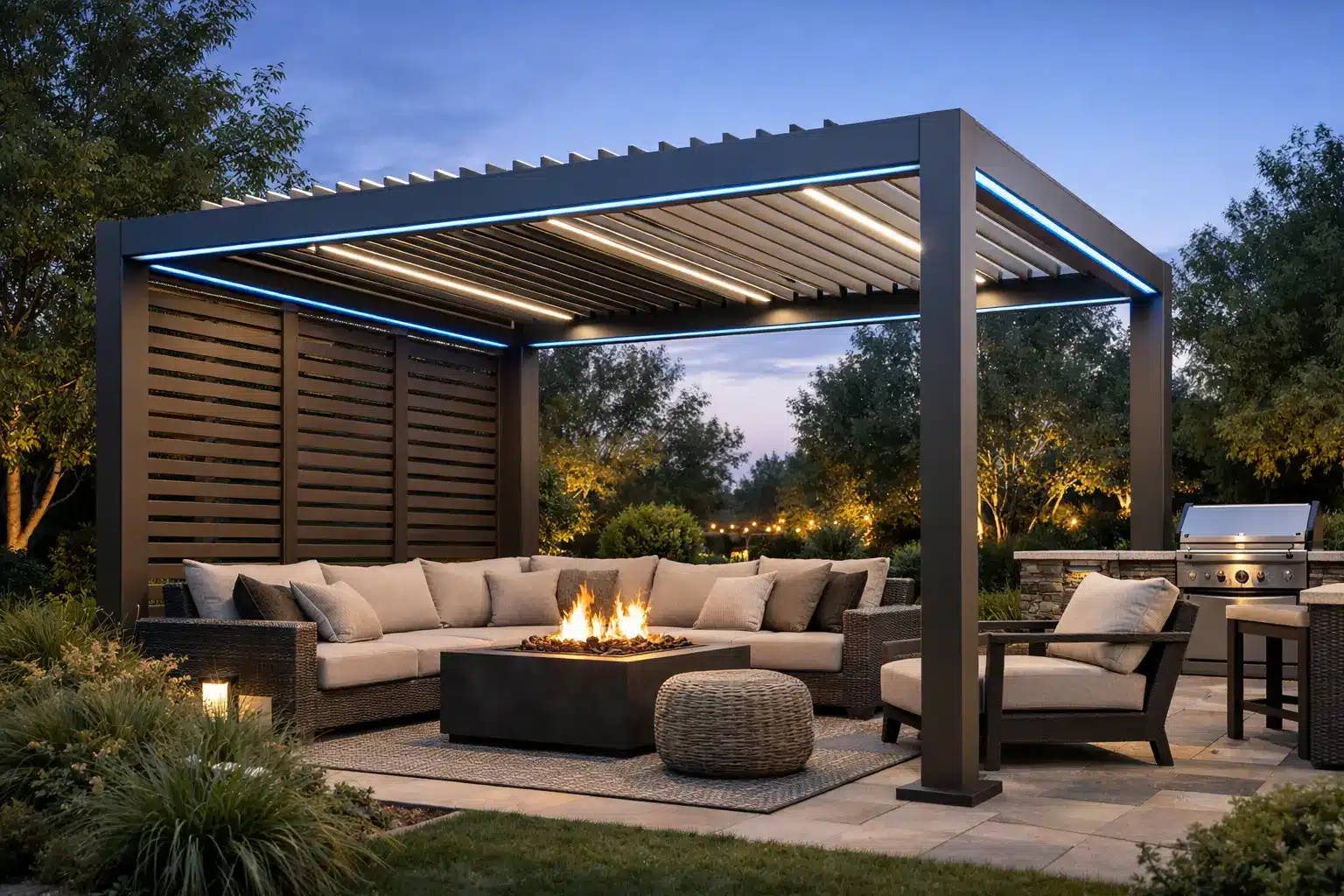
A pergola that looks beautiful from the pool deck but leaves you exposed to the neighbor’s second-story window is not finished design – it is only partial design. If you are planning how to design pergola for privacy, the goal is not simply to block views. It is to create a space that feels protected, comfortable, and architecturally intentional without sacrificing airflow, light, or the clean lines that make a premium outdoor structure worth the investment.
For Florida homeowners, privacy design also has to work harder. Outdoor living is nearly year-round, lots are often close together, and weather can shift quickly from harsh sun to wind-driven rain. That means the right pergola privacy strategy should balance sightlines, shade, storm performance, and daily usability.
Start with the views you want to block
The biggest mistake in privacy planning is assuming every side of the pergola needs the same treatment. In most properties, only one or two directions create the real issue. It might be a neighboring lanai, a busy golf course path, a street-facing pool deck, or an elevated balcony that looks directly into your outdoor seating area.
Start by standing or sitting where you will actually use the space. Look outward from the dining table, lounge seating, outdoor kitchen, and spa area. Privacy should be designed from the user’s perspective, not from a flat site plan alone. A pergola can feel open and expansive in one direction while being carefully screened in another, and that selective approach usually delivers a more refined result.
This is also where height matters. A low-angle view from next door requires a different solution than an overlooking second story. Side privacy panels may solve one condition, while overhead louvers or drop screens may be more effective for another.
How to design pergola for privacy without making it feel closed in
Luxury outdoor design works best when privacy feels integrated, not added on as an afterthought. If every opening is heavily blocked, the pergola may lose the airy, architectural quality that makes outdoor living enjoyable in the first place.
A better approach is layered privacy. That usually means combining overhead control with selective vertical screening. Motorized louvers help manage sun angle and visibility from above, while perimeter elements such as privacy walls, slatted panels, or automated shades handle side exposure. Together, they create a space that feels sheltered rather than boxed in.
There is always a trade-off. More enclosure usually means greater privacy and sun protection, but it can also reduce cross ventilation and alter the openness of the structure. Less enclosure preserves expansive views and airflow, but may leave key seating zones exposed at certain times of day. The right answer depends on how you use the space and how much flexibility you want built into it.
Choose privacy features that can adapt
Fixed privacy elements have their place, especially when a problematic sightline never changes. But many homeowners want more control than a static wall can provide. That is where operable systems become especially valuable.
Motorized louvers allow you to adjust overhead coverage as the sun moves and as nearby sightlines shift. In the morning, a space may feel private enough. By late afternoon, when neighboring windows catch a direct angle into the pergola, louver positioning can make the area feel far more protected.
Automated shades add another level of control. They are especially effective when privacy needs change by season, event, or time of day. If you entertain often, shades let you close down the space for a dinner party and open it back up when you want a broader view of the landscape. That flexibility is one of the clearest differences between a decorative pergola and a true outdoor living system.
For high-end homes, adaptability also supports better aesthetics. Instead of permanently overbuilding the structure to solve every possible condition, you can preserve a cleaner design and deploy privacy features only when needed.
Think in zones, not just structure
Pergola privacy becomes more successful when the space beneath it is planned in zones. A lounge area where guests relax for an hour needs more shielding than a circulation path someone crosses in ten seconds. An outdoor dining area may benefit from side screening at seated eye level, while a grilling zone may require more openness for ventilation and movement.
This is why furniture layout should be part of the pergola design conversation from the beginning. The exact placement of a sofa, dining table, or chaise lounge changes which views matter and where privacy elements should be concentrated. Even a small shift in orientation can improve comfort without adding more material.
For example, rotating the primary seating arrangement away from the most exposed edge may reduce the amount of screening needed. Positioning a dining table deeper under the pergola can create a stronger sense of enclosure while keeping the perimeter visually lighter. Good privacy design is often as much about planning where people gather as it is about adding panels.
Use lines, spacing, and opacity deliberately
Not all privacy screens perform the same way. Some fully block views. Others filter them. In many luxury settings, filtered privacy is the better choice because it softens exposure without making the pergola feel visually heavy.
Horizontal or vertical slatted panels can be designed to limit direct sightlines while still allowing airflow and daylight. The spacing matters. Wider gaps feel lighter but offer less privacy, while tighter spacing creates more protection and a stronger architectural presence. What looks perfect in an elevation drawing may feel too exposed in real life if the spacing is too generous for the neighbor’s angle of view.
Opacity matters too. A solid panel can create a dramatic sense of retreat, but using too many solid surfaces may make the pergola feel detached from the rest of the property. Partial screening often creates a better balance, especially when the goal is privacy with openness rather than total enclosure.
Plan for Florida weather, not just privacy
In Florida, privacy design cannot be separated from performance. Any vertical element attached to a pergola affects how the structure handles wind, rain, and long-term exposure. That is one reason engineering should lead the conversation, especially in coastal and hurricane-prone areas.
A privacy feature that looks appealing in a showroom may not be the right answer for a property in Boca Raton, Naples, or Tampa where storm resilience matters as much as appearance. Screens, louvers, and side panels should be considered as part of an integrated system, not independent accessories. The structure, attachments, and operating components all need to work together.
This is where premium aluminum pergola systems stand apart. When the pergola is engineered as a true all-weather outdoor structure, privacy features can be incorporated without compromising confidence in the build. That matters for daily comfort, but it matters even more for long-term ownership. A refined design should also be a dependable one.
Lighting can increase privacy after dark
Many homeowners focus on daytime exposure and forget how dramatically privacy changes at night. Once the sun goes down, interior house lights, pool lighting, and pergola lighting all affect how visible the space feels from outside.
Integrated lighting should be planned to create comfort without turning the pergola into a stage. Warm, controlled illumination placed within the structure tends to feel more intimate than broad flood-style lighting. It also helps define the pergola as a destination rather than a brightly exposed platform.
This is another argument for designing privacy as a full experience. Shade, sightlines, lighting, and layout work together. If one element is ignored, the space may never feel fully resolved.
Privacy should match the home’s architecture
A pergola designed for privacy should look like it belongs to the property, not like a problem-solving add-on. Clean proportions, thoughtful alignment with the home, and carefully selected side treatments preserve the value of the architecture.
This is especially important in upscale homes where the pergola is visible from interior living spaces. The structure should feel like a premium extension of the residence, not a separate backyard object. Privacy panels, screens, and louvers should echo the home’s scale and modernity, while still being practical for outdoor use.
That balance is where consultative design matters. A specialist builder can help you solve the privacy problem without overcorrecting and making the structure heavier, darker, or more enclosed than it needs to be.
When to prioritize custom design
If your property has close side setbacks, elevated neighboring homes, a pool deck with little existing cover, or a strong desire for year-round entertaining, custom design is usually worth it. Privacy in those settings is rarely solved by standard dimensions or one-size-fits-all features.
A custom approach allows the pergola to respond to your exact lot, exposure, and lifestyle. It also gives you more control over how much privacy is fixed versus adjustable. For homeowners who want a polished outdoor retreat with strong weather performance, that level of planning tends to pay off in both comfort and long-term satisfaction.
enVision Pergola approaches this as a design and engineering decision, not just a product selection, which is exactly how privacy should be handled on a premium Florida property.
The best pergola privacy design does not announce itself. It simply makes the space feel calmer, more protected, and more usable every time you step outside.